

CRESCENT Virtual Sessions
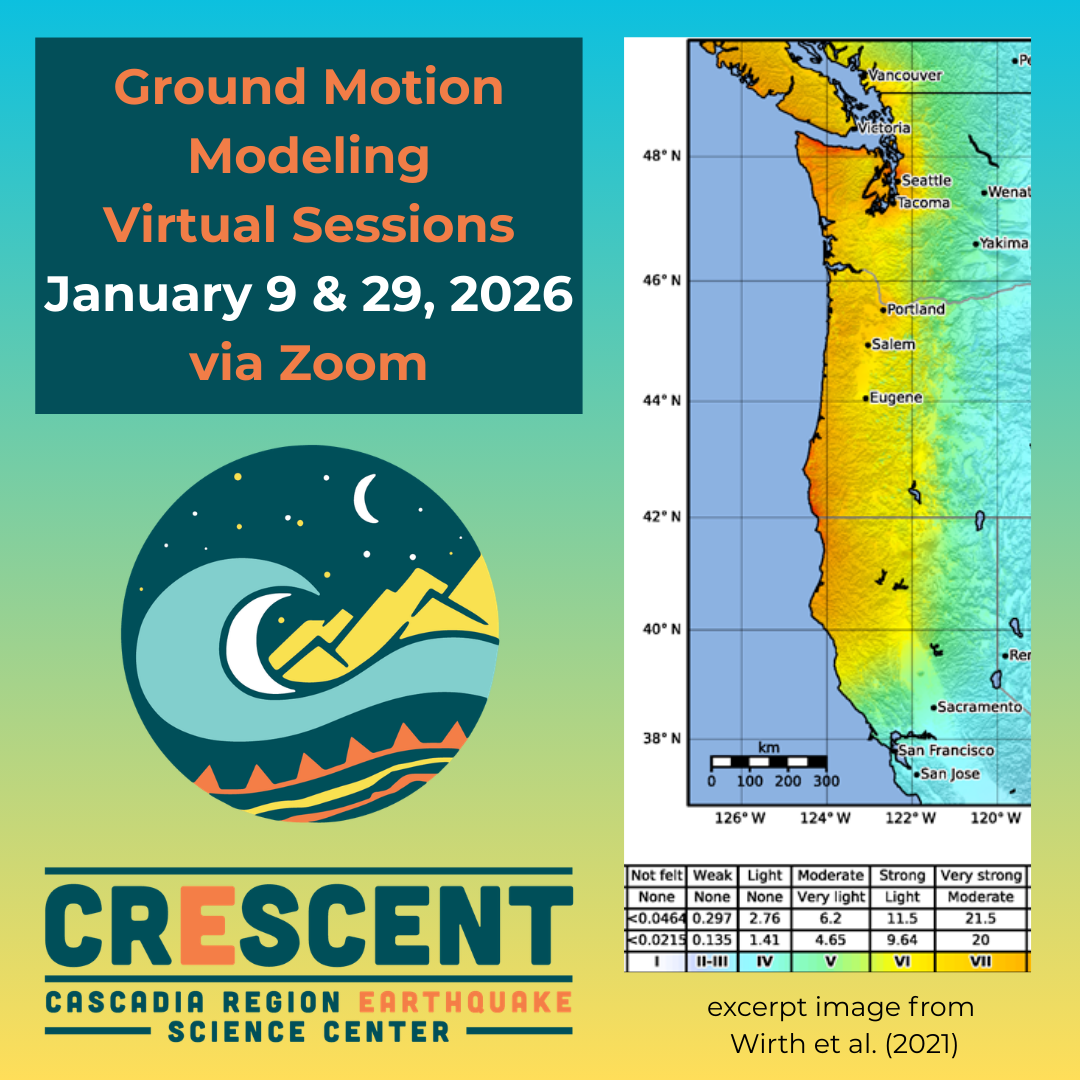
Ground Motion Modeling
January 9 and 29, 2026
Virtual Session Goals

The goal of the Ground Motion Modeling Topical Workshop is to define from a community perspective the broad needs, goals, and directions of ground motion modeling and hazard in Cascadia and to identify priorities in fundamental and applied science directions for the next decade. The desired outcome is to write a peer reviewed roadmap or opinion piece for this frontier.
The Ground Motion Modeling Topical Workshop originally scheduled for October 2025 was postponed. We are continuing to pursue our goals through two virtual sessions conducted January 9 and 29, followed by an in-person workshop coming up on Wednesday, May 27, 2026.
Virtual session agendas, slides and video recordings are available on this page. Click on the button below for information on the May 27, 2026 in-person workshop.
Attendance
Virtual sessions were conducted on zoom – see video recordings and available slide decks in agendas below.
Friday, January 9, 9-11 am PST: “Outputs: What ground motion estimation in Cascadia needs to address”
Thursday. January 29, 9-11 am PST: “Inputs and Methodologies”
For more information, please contact us at cascadiaquakes@uoregon.edu.
Virtual Session Agendas and Resources
Recordings
Friday, January 9, 2026 – “Outputs: What ground motion estimation in Cascadia needs to address“
Presentation slides – See links in agenda below for slide decks
9:00 – 11:00 am P.S.T., on zoom
- Albert Kottke (PG&E): “Importance of Spatially Varying Ground Motion Models and Implications for Cascadia”
- Jeff Berman (UW): “Ground motion considerations for the built environment in Cascadia”
- Brett Maurer (UW): “Ground Motions and Ground Failure: Looking Mostly Forward and A Little Bit Backward”
- Morgan Moschetti (USGS): “Ground-motion modeling in Cascadia for the U.S. National Seismic Hazard Model: Current modeling approaches and open questions”
- Karen Sung (UC Berkeley): “Implementing Simulations in Ground Motion Models: Practical Needs and Challenges”
- Q&A and Discussion
Thursday, January 29, 2026 – “Inputs and Methodologies”
Presentation slides – See links in agenda below for available slide decks
9:00 – 11:00 am P.S.T., on zoom
- Zoe Krauss (UW): “PNW Earthquake Catalogs and Waveform Data”
- Audrey Dunham (USGS): “Large-Scale Simulations for Improved Seismic Hazard Characterization in Cascadia”
- Pieter Share (OSU): “Supplementing the shallow CRESCENT CVM: High-Resolution Sedimentary and Shallow Crustal Structure for Ground Motion Studies from Nodal Array Adjoint Tomography”
- alex grant (USGS): “Geologic constraints on Cascadia paleoearthquake shaking intensities”
- Grigorios Lavrentiadas (University at Buffalo): “A Non-Ergodic Ground Motion Model for the Groningen, Netherlands: Merging Physics-Based Simulations and Empirical Observations”
- Alice Gabriel (UCSD): “Near-Instantaneous physics-based reduced-order modeling for shake maps, seismograms, dynamic rupture and the seismic cycle”
- Q&A and Discussion
Workshop Planning Committee
Valerie Sahakian
University of Oregon
vjs@uoregon.edu
Alice Gabriel
University of California, San Diego
algabriel@ucsd.edu
Erin (Wirth) Moriarty
United States Geological Survey
emoriarty@usgs.gov

Emrah Yenier
Haley & Aldrich
EYenier@haleyaldrich.com

Chih-Hsuan Sung
University of California, Berkeley
karensung@berkeley.edu
alex grant
United States Geological Survey
agrant@usgs.gov
Brett Maurer
University of Washington
bwmaurer@uw.edu
Norman Abrahamson
University of California, Berkeley
abrahamson@berkeley.edu

Morgan Moschetti
United States Geological Survey
mmoschetti@usgs.gov
