Past Events

Past

C3S Transient Detection Exercise Informational Session

November 5, 2026

The C3S working group is organizing a community exercise to evaluate and compare approaches for detecting slow slip events along the Cascadia Subduction Zone from continuous GNSS observations. All participants work with a common 2010–2025 dataset and submit candidate events in a standardized format, providing a basis for comparing different detection approaches.

The exercise is intended to encourage collaboration, reproducibility, and the development of new approaches, with code and results remaining available for ongoing community use. Exercise documentation and submission links are provided below.

C3S Transient Detection Exercise Informational Session Read More »
Cascadia Subduction Zone Earthquake Presentations

September 15 & 30, October 14, 21 & 26, 2026

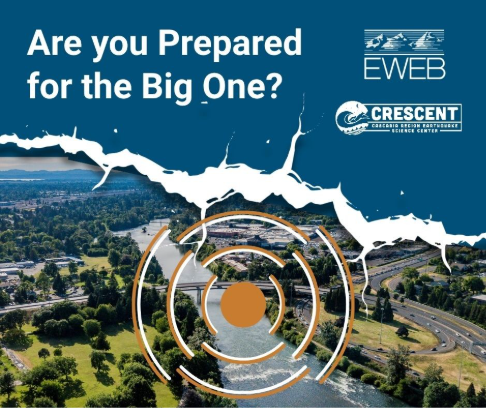
Join EWEB and CRESCENT at the YMCA for an informative session on the Cascadia Subduction Zone and what a major earthquake could mean for the Eugene area. Learn what to expect during a seismic event, understand the potential impacts on community infrastructure, and discover practical ways to prepare your household through EWEB’s Pledge to Prepare program.

Cascadia Subduction Zone Earthquake Presentations Read More »

2026 Great Oregon ShakeOut

On October 15, 2026, the University of Oregon joins millions of others across the world to participate in ShakeOut, an annual earthquake awareness drill. Participants practice how to protect themselves during an earthquake – the researched three steps of “Drop, Cover, and Hold On” should be performed as soon as shaking is felt or you receive an earthquake early warning alert.

2026 Great Oregon ShakeOut Read More »

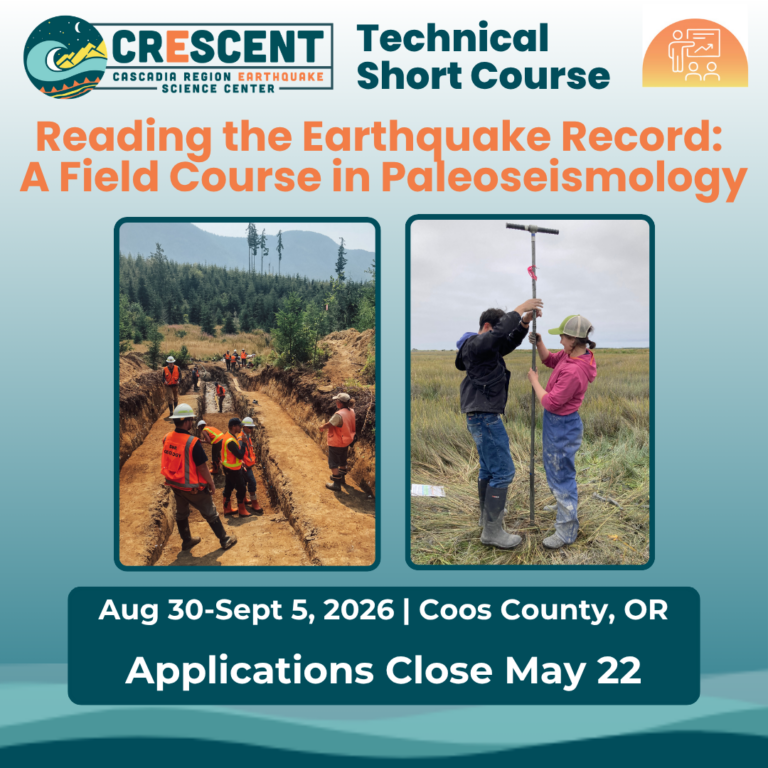
Paleoseismology Technical Short Course

Led by members of the Cascadia Paleoseismology (CPAL) and Community Fault Model (CFM) working groups, this five-day, field-based technical short course exposes participants to paleoearthquake studies and their application to understanding fault behavior in space and time. Integrated topics include subsidence stratigraphy, ecology-based paleoseismic studies, tsunami deposit mapping, trench-based paleoseismology, high-resolution lidar topography, and surficial geologic mapping. Based at the Oregon Institute of Marine Biology in Charleston, the course includes limited classroom time and 4.5 days of fieldwork in the marshes and adjacent uplands of Coos Bay on Oregon’s southern coast.

Application closes May 22, 2026.

Paleoseismology Technical Short Course Read More »

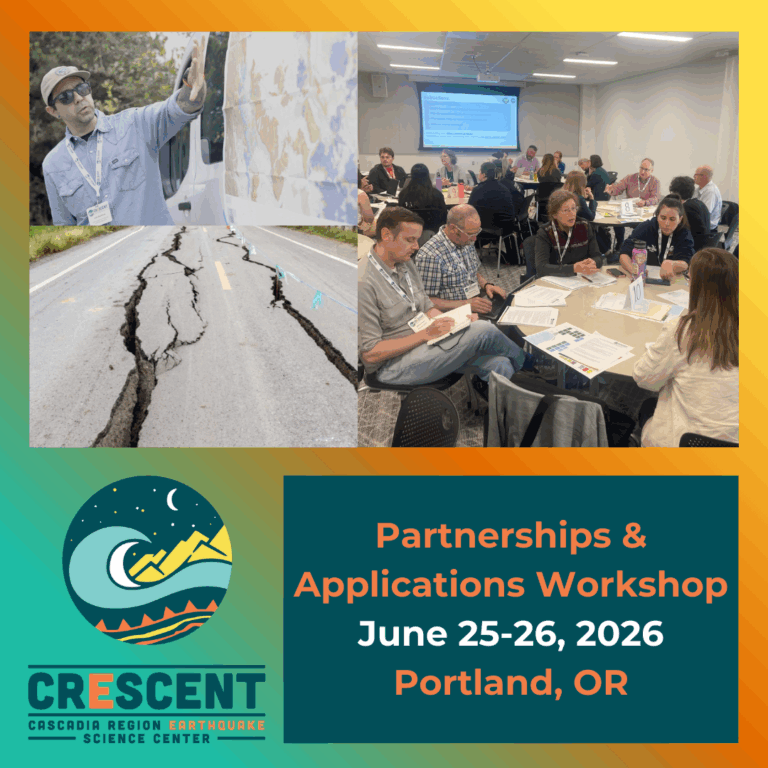
2026 Partnerships & Applications Workshop

This is the third Partnerships & Application workshop, designed to explore the challenges and needs of the multi-disciplinary community involved in earthquake hazard study and mitigation in the Pacific Northwest. Workshop discussions in 2024 and 2025 highlighted universal interest in developing scenarios and inter-organizational exercises for preparedness and response as a priority next step. Consequently, a deeper consideration of scenarios has been selected as the central theme for the 2026 P&A workshop.

2026 Partnerships & Applications Workshop Read More »

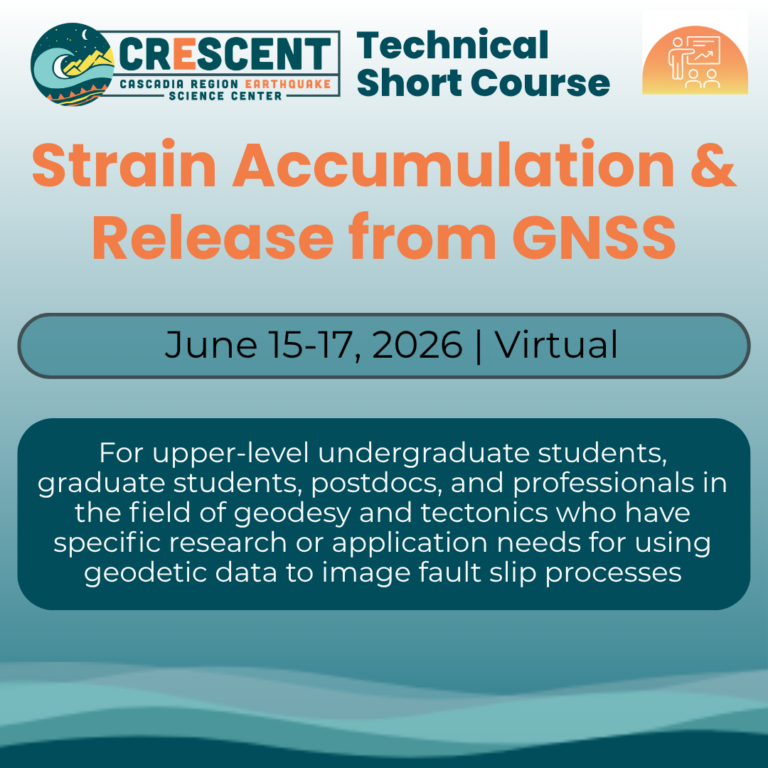
Geodesy Technical Short Course

Led by members of the Coupling, Seismicity, and Slow Slip (C3S) working group, this technical short course provides requisite tools for recognizing how earthquake cycle signatures in the Cascadia Subduction Zone are expressed in geodetic observations. It will introduce basic processing of geodetic time series to interpret longer-term strain accumulation processes and slow slip events.

Applications are closed.

Geodesy Technical Short Course Read More »

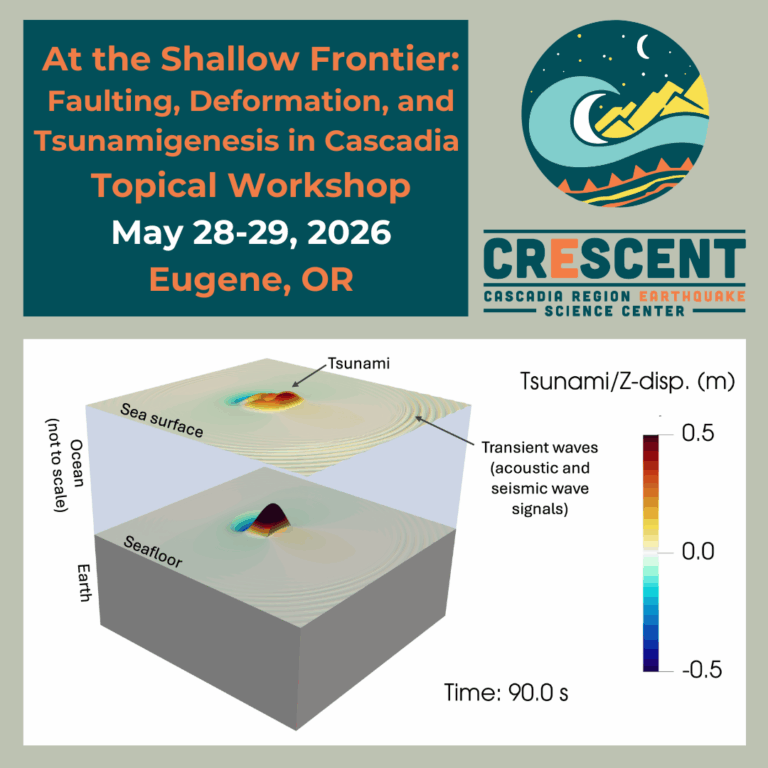
DET Topical Workshop

This interdisciplinary workshop aims to integrate experimental, imaging, and modeling studies on shallow faulting and deformation and tsunamigenesis for the Cascadia Subduction Zone.  We welcome participants interested in frictional fault properties, aseismic slip, fluid pressure, splay faulting, off-fault deformation, acoustic laboratory studies, seafloor geodesy and remote sensing, and offshore DAS.  The workshop will generate a community white paper focusing on how to better account for the complexity of shallow deformation to assess tsunami hazard for Cascadia. 

DET Topical Workshop Read More »

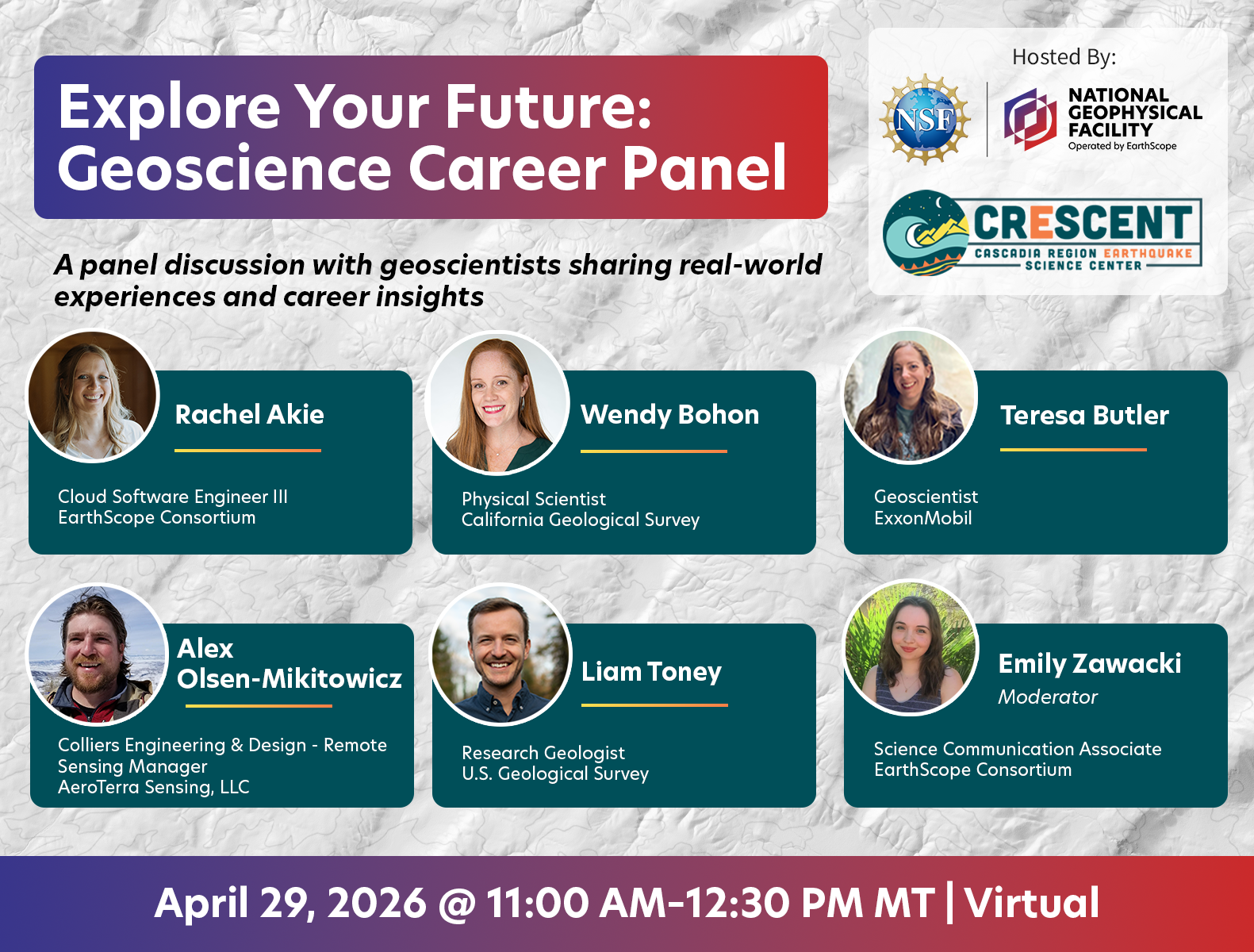
Spring 2026 Career Panel

What can you do with a geoscience degree?

Join the EarthScope Consortium-opterated NSF National Geophysical Facility and CRESCENT for a Geoscience Career Panel webinar showcasing diverse career paths across academia, industry, government, nonprofit, consulting, and beyond.

Spring 2026 Career Panel Read More »