Events

Small Grants

2024-25 Seed Grant Awards

The CRESCENT Seed Grant Program has the dual goals of broadening community participation and increasing the breadth of scientific investigations related to the center’s goals. The center invited the community to participate through a proposal call to address key scientific challenges identified through CRESCENT’s three major pillars. This year we had 33 seed grant applicants of which 11 were funded.

2024-25 Seed Grant Awards Read More »

May 2025 Newsletter

Read about: CRESCENT Community Velocity Model and Community Fault Model viewer release, topical workshops, geoscience education programs and outreach, University of Oregon seismic hazard monitoring and resilience research, new publications, upcoming events… and more in the latest edition of “Seismic Moment” – CRESCENT’s Quarterly Newsletter.

May 2025 Newsletter Read More »

February Newsletter

Read about: CRESCENT Community Velocity Model progress, Offshore Observations Special Interest Group updates, earthquake catalog development, Geoscience Education & Inclusion STEM programs, Fellowship awardees and training courses, Partnerships & Applications Workshop 2025, Cascadia megaquake 325th anniversary events, Washington Geological Survey resources, publications, recognitions, upcoming events… and more in the latest edition of “Seismic Moment” – CRESCENT’s Quarterly Newsletter.

February Newsletter Read More »

Community Fault Model Topical Workshop

A workshop to solicit input from the community on the CRESCENT Community Fault Model (CFM) v1.0 and discuss improvements for future versions of the CFM. The workshop will highlight the current goals, criteria for inclusion, and status of the CFM. We welcome participants to share new results from both previously known and newly discovered fault systems in both onshore and offshore regions of Cascadia. The workshop will focus on faults in both the upper plate (North America), the lower plate (Juan de Fuca), and the plate interface.

Community Fault Model Topical Workshop Read More »

2025 Partnerships & Applications Workshop

Following the first iteration of this workshop in June 2024, this two-day event is designed to explore the emergent challenges and needs of the multi-disciplinary community involved in earthquake hazard study and mitigation in the Pacific Northwest. A mix of CRESCENT research updates, community presentations, and facilitated discussion sessions will address the following themes:

-Science communication
-Emergency preparedness and response
-Data availability and access
-Resource limitations

2025 Partnerships & Applications Workshop Read More »

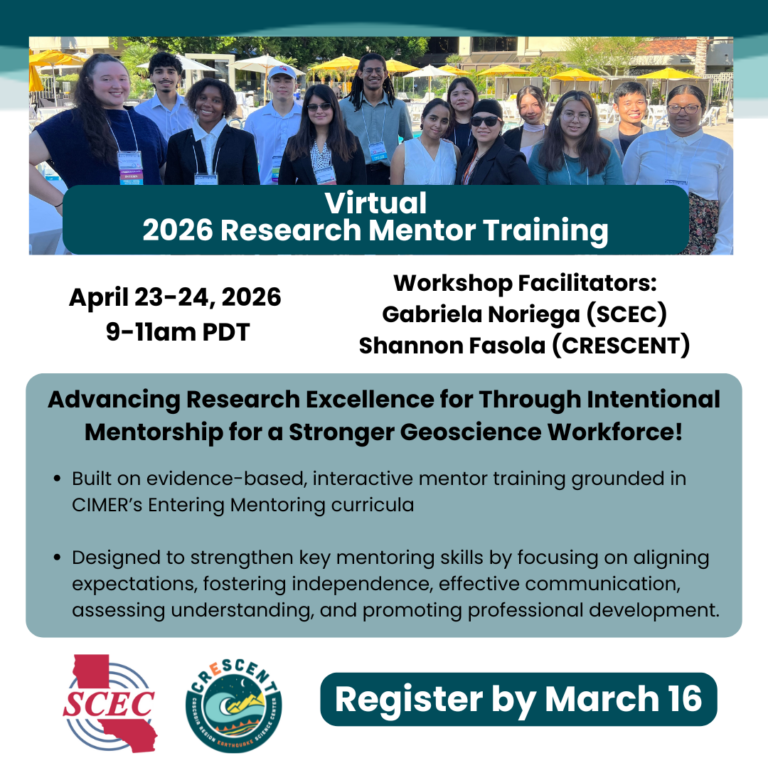
Spring 2025 Mentor Training

Advancing Research Excellence for Through Intentional Mentorship for a Stronger Geoscience Workforce!

Statewide California Earthquake Center – SCEC and CRESCENT are co-facilitating an interactive training designed to help mentors develop skills for engaging in productive, culturally responsive, research mentoring relationships– relationships that optimize the success of both mentors and mentees. This training is built on the evidence-based Entering Mentoring curriculum from the Center for the Improvement of Mentored Experience in Research (CIMER).

This workshop is open to researchers at all career stages who are interested in strengthening their mentoring skills.

Spring 2025 Mentor Training Read More »

DET Topical Workshop

This interdisciplinary workshop aims to integrate experimental, imaging, and modeling studies on shallow faulting and deformation and tsunamigenesis for the Cascadia Subduction Zone.  We welcome participants interested in frictional fault properties, aseismic slip, fluid pressure, splay faulting, off-fault deformation, acoustic laboratory studies, seafloor geodesy and remote sensing, and offshore DAS.  The workshop will generate a community white paper focusing on how to better account for the complexity of shallow deformation to assess tsunami hazard for Cascadia. 

DET Topical Workshop Read More »

Geodesy Technical Short Course

Led by members of the Coupling, Seismicity, and Slow Slip (C3S) working group, this technical short course provides requisite tools for recognizing how earthquake cycle signatures in the Cascadia Subduction Zone are expressed in geodetic observations. It will introduce basic processing of geodetic time series to interpret longer-term strain accumulation processes and slow slip events.

Application closes April 15, 2026.

Geodesy Technical Short Course Read More »

Paleoseismology Technical Short Course

Led by members of the Cascadia Paleoseismology (CPAL) and Community Fault Model (CFM) working groups, this five-day, field-based technical short course exposes participants to paleoearthquake studies and their application to understanding fault behavior in space and time. Integrated topics include subsidence stratigraphy, ecology-based paleoseismic studies, tsunami deposit mapping, trench-based paleoseismology, high-resolution lidar topography, and surficial geologic mapping. Based at the Oregon Institute of Marine Biology in Charleston, the course includes limited classroom time and 4.5 days of fieldwork in the marshes and adjacent uplands of Coos Bay on Oregon’s southern coast.

Application closes May 22, 2026.

Paleoseismology Technical Short Course Read More »