Events

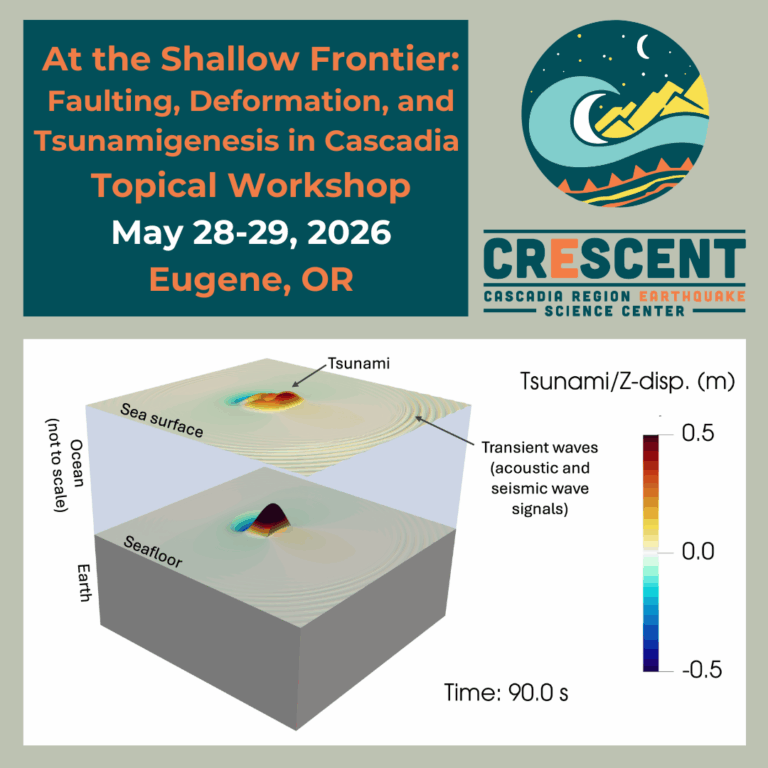
DET Topical Workshop

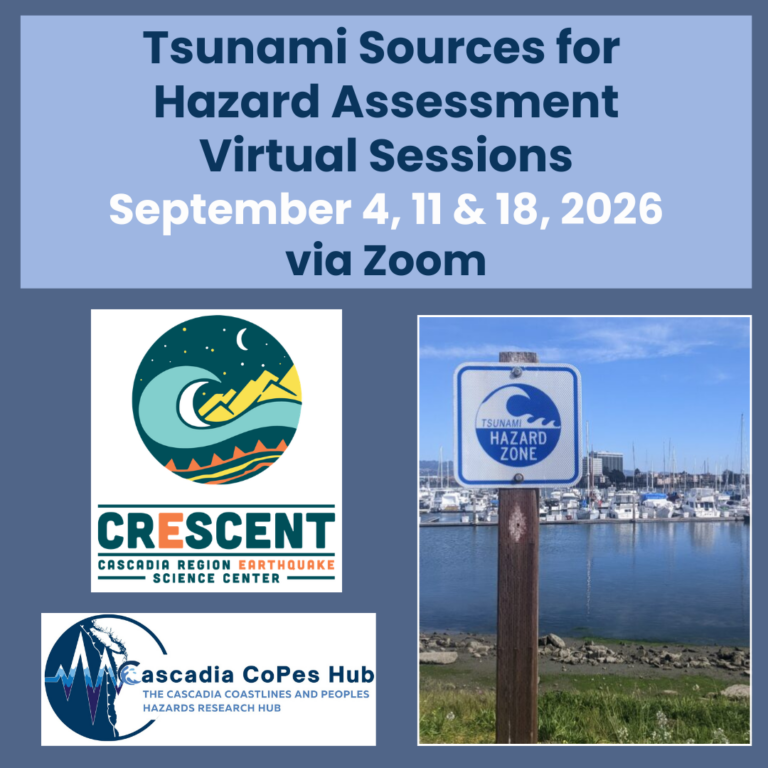
This interdisciplinary workshop aims to integrate experimental, imaging, and modeling studies on shallow faulting and deformation and tsunamigenesis for the Cascadia Subduction Zone.  We welcome participants interested in frictional fault properties, aseismic slip, fluid pressure, splay faulting, off-fault deformation, acoustic laboratory studies, seafloor geodesy and remote sensing, and offshore DAS.  The workshop will generate a community white paper focusing on how to better account for the complexity of shallow deformation to assess tsunami hazard for Cascadia. 

DET Topical Workshop Read More »

Geodesy Technical Short Course

Led by members of the Coupling, Seismicity, and Slow Slip (C3S) working group, this technical short course provides requisite tools for recognizing how earthquake cycle signatures in the Cascadia Subduction Zone are expressed in geodetic observations. It will introduce basic processing of geodetic time series to interpret longer-term strain accumulation processes and slow slip events.

Applications are closed.

Geodesy Technical Short Course Read More »

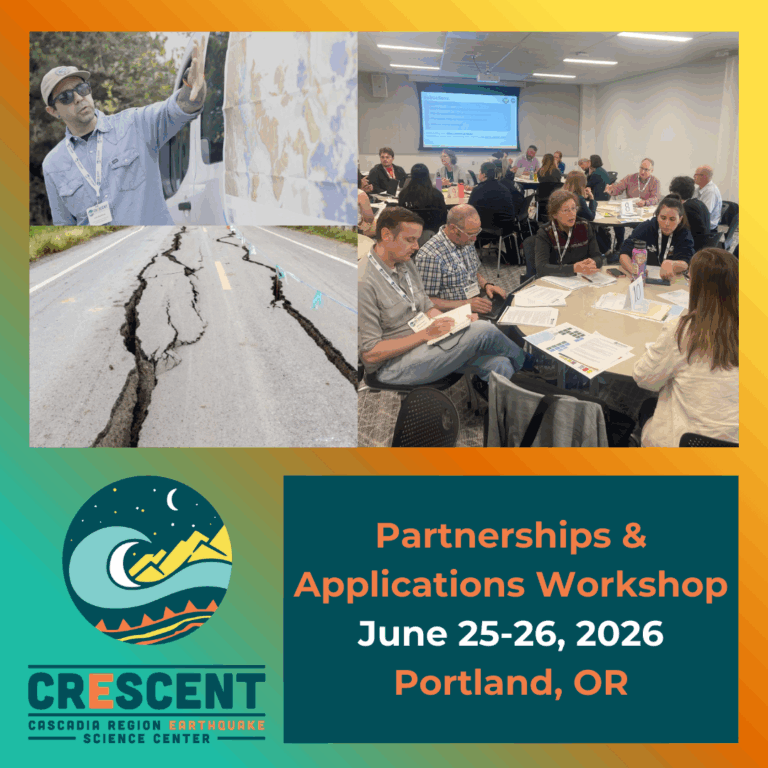
2026 Partnerships & Applications Workshop

This is the third Partnerships & Application workshop, designed to explore the challenges and needs of the multi-disciplinary community involved in earthquake hazard study and mitigation in the Pacific Northwest. Workshop discussions in 2024 and 2025 highlighted universal interest in developing scenarios and inter-organizational exercises for preparedness and response as a priority next step. Consequently, a deeper consideration of scenarios has been selected as the central theme for the 2026 P&A workshop.

2026 Partnerships & Applications Workshop Read More »

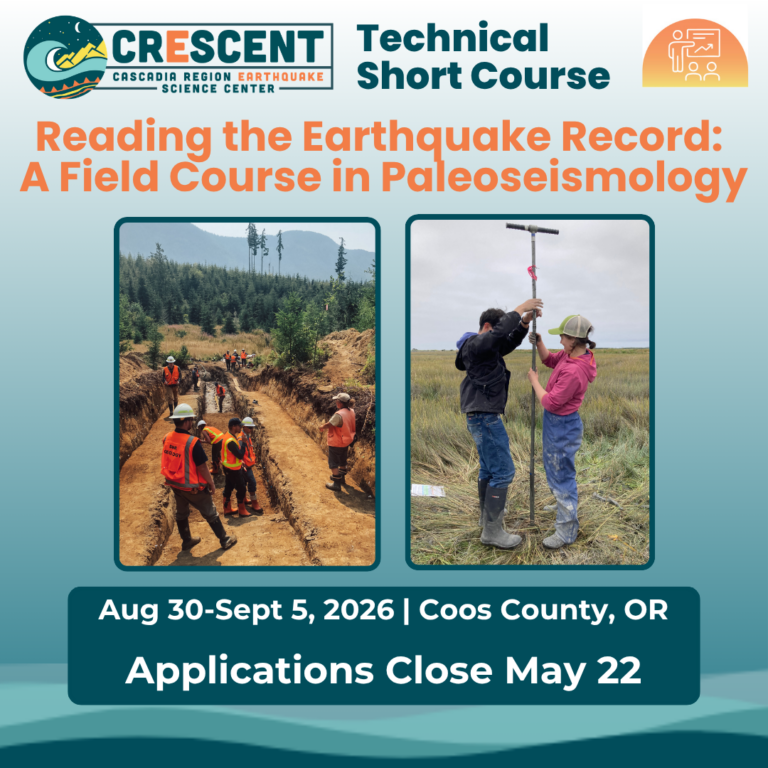
Paleoseismology Technical Short Course

Led by members of the Cascadia Paleoseismology (CPAL) and Community Fault Model (CFM) working groups, this five-day, field-based technical short course exposes participants to paleoearthquake studies and their application to understanding fault behavior in space and time. Integrated topics include subsidence stratigraphy, ecology-based paleoseismic studies, tsunami deposit mapping, trench-based paleoseismology, high-resolution lidar topography, and surficial geologic mapping. Based at the Oregon Institute of Marine Biology in Charleston, the course includes limited classroom time and 4.5 days of fieldwork in the marshes and adjacent uplands of Coos Bay on Oregon’s southern coast.

Application closes May 22, 2026.

Paleoseismology Technical Short Course Read More »

QGIS Toolkit Product Release

CRESCENT is pleased to share a new set of open-source tools for building realistic 3D fault surfaces directly in QGIS (a free, cross-platform GIS application). These tools are designed to help researchers create non-planar, data-constrained fault geometries from standard geologic and geophysical inputs, including geologic maps, balanced cross-sections, seismic images, and earthquake hypocenters.

QGIS Toolkit Product Release Read More »

Tsunami Forecasting Breakthrough Earns Gordon Bell Prize

We’re thrilled to share that a team led by Stefan Henneking and Omar Ghattas at UT Austin has been awarded the ACM Gordon Bell Prize for their work on real-time tsunami forecasting in Cascadia. The author team also includes CRESCENT senior personnel Alice-Agnes Gabriel, from UC San Diego, who leads our Dynamic Rupture, Earthquake Cycles, and Tsunamis (DET) working group and showcased this work at our annual meeting in Seattle last month.

Tsunami Forecasting Breakthrough Earns Gordon Bell Prize Read More »

Offshore Observations Topical Workshop

In an effort to coordinate future offshore science in Cascadia, we are designing the Offshore Observations workshop to bring together geoscientists across a variety of disciplines that use offshore datasets to study subduction zones. The workshop will comprise a series of short talk sessions followed by breakout groups. Session topics include fluid pathways and hydrology of subduction zones, constraints on megathrust locking state and shallow slow slip, accretionary wedge deformation, structure of the incoming plate, and future plans for ocean drilling, fiber-optic sensing, and cabled infrastructure.

Offshore Observations Topical Workshop Read More »