Events

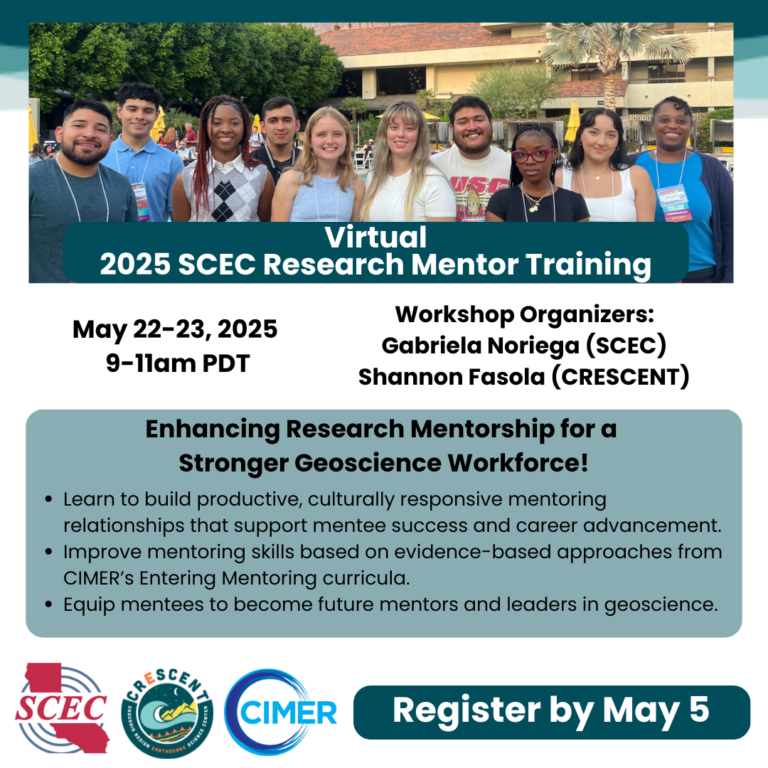
Spring 2025 Mentor Training

Advancing Research Excellence for Through Intentional Mentorship for a Stronger Geoscience Workforce!

Statewide California Earthquake Center – SCEC and CRESCENT are co-facilitating an interactive training designed to help mentors develop skills for engaging in productive, culturally responsive, research mentoring relationships– relationships that optimize the success of both mentors and mentees. This training is built on the evidence-based Entering Mentoring curriculum from the Center for the Improvement of Mentored Experience in Research (CIMER).

This workshop is open to researchers at all career stages who are interested in strengthening their mentoring skills.

Spring 2025 Mentor Training Read More »
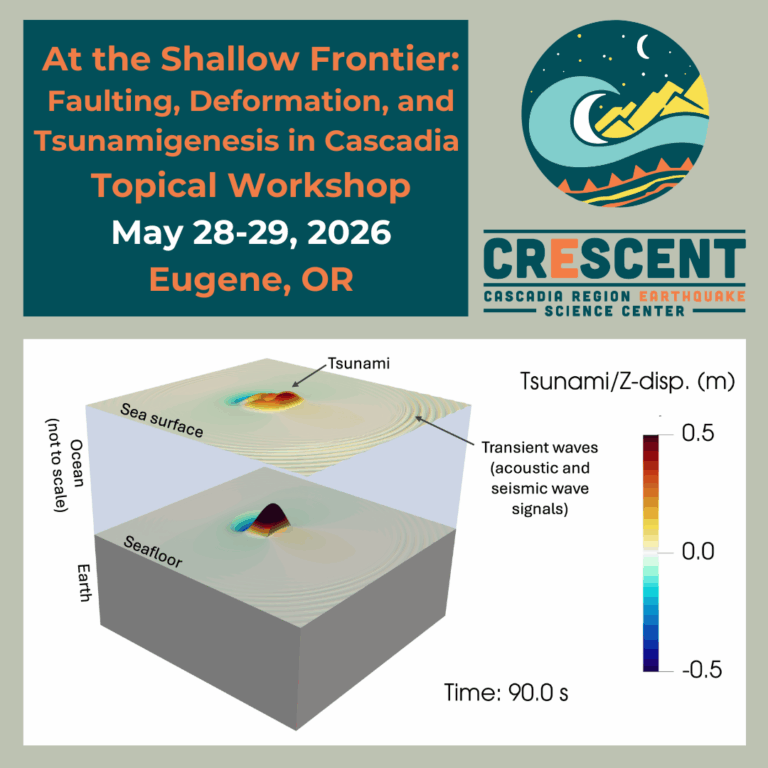
DET Topical Workshop

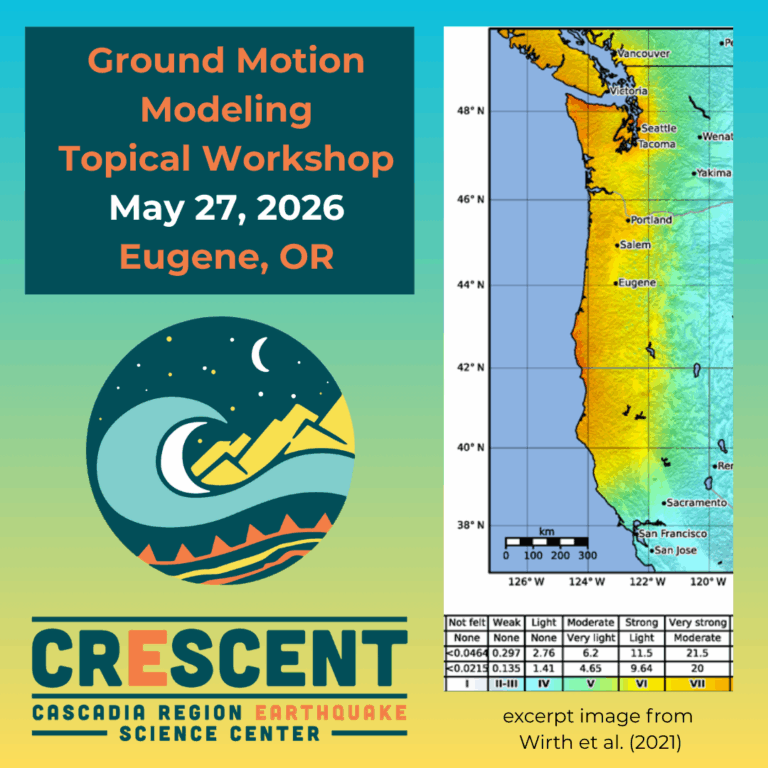
This interdisciplinary workshop aims to integrate experimental, imaging, and modeling studies on shallow faulting and deformation and tsunamigenesis for the Cascadia Subduction Zone.  We welcome participants interested in frictional fault properties, aseismic slip, fluid pressure, splay faulting, off-fault deformation, acoustic laboratory studies, seafloor geodesy and remote sensing, and offshore DAS.  The workshop will generate a community white paper focusing on how to better account for the complexity of shallow deformation to assess tsunami hazard for Cascadia. 

DET Topical Workshop Read More »

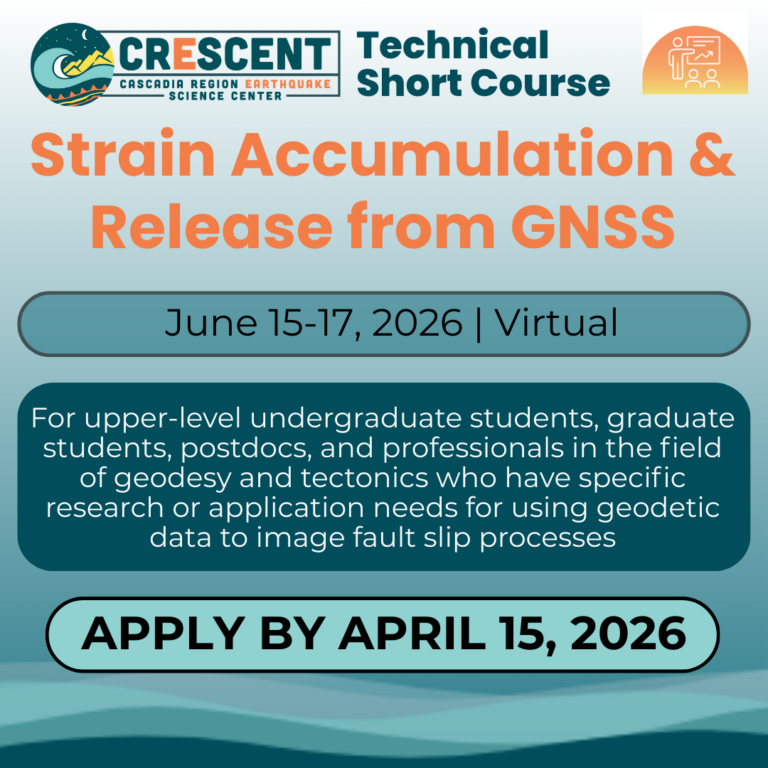
Geodesy Technical Short Course

Led by members of the Coupling, Seismicity, and Slow Slip (C3S) working group, this technical short course provides requisite tools for recognizing how earthquake cycle signatures in the Cascadia Subduction Zone are expressed in geodetic observations. It will introduce basic processing of geodetic time series to interpret longer-term strain accumulation processes and slow slip events.

Application closes April 15, 2026.

Geodesy Technical Short Course Read More »

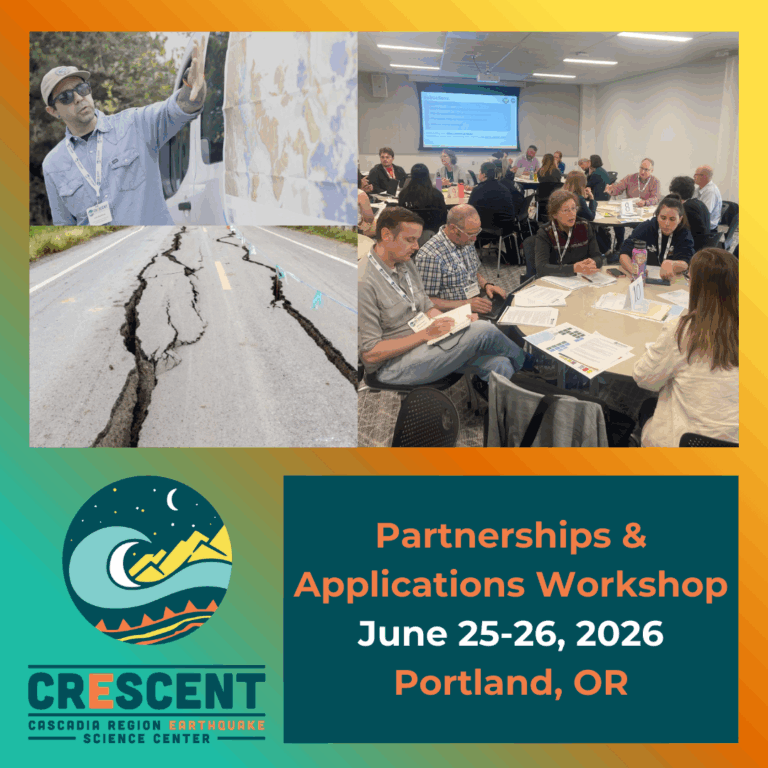
2026 Partnerships & Applications Workshop

This is the third Partnerships & Application workshop, designed to explore the challenges and needs of the multi-disciplinary community involved in earthquake hazard study and mitigation in the Pacific Northwest. Workshop discussions in 2024 and 2025 highlighted universal interest in developing scenarios and inter-organizational exercises for preparedness and response as a priority next step. Consequently, a deeper consideration of scenarios has been selected as the central theme for the 2026 P&A workshop.

2026 Partnerships & Applications Workshop Read More »

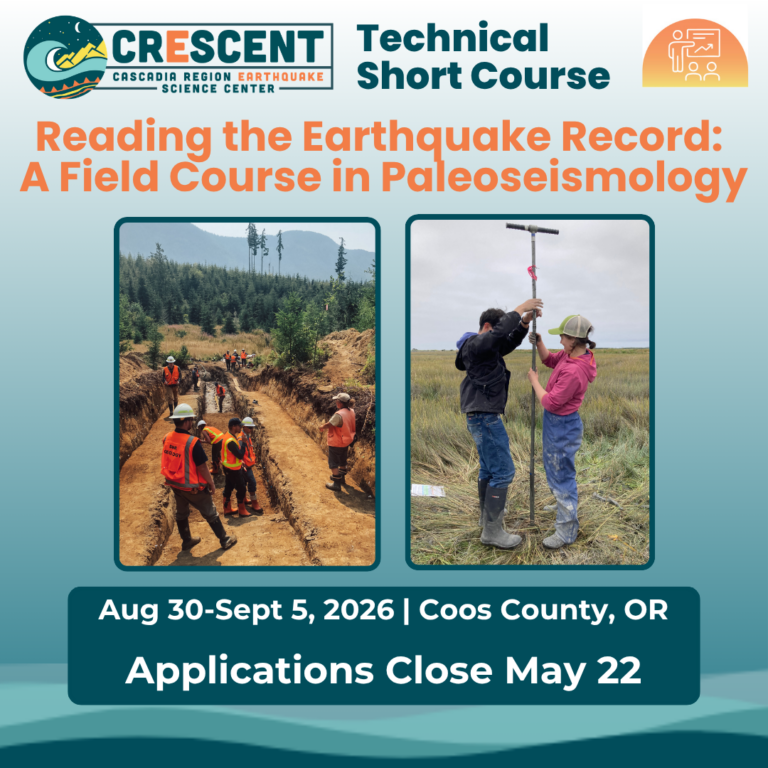
Paleoseismology Technical Short Course

Led by members of the Cascadia Paleoseismology (CPAL) and Community Fault Model (CFM) working groups, this five-day, field-based technical short course exposes participants to paleoearthquake studies and their application to understanding fault behavior in space and time. Integrated topics include subsidence stratigraphy, ecology-based paleoseismic studies, tsunami deposit mapping, trench-based paleoseismology, high-resolution lidar topography, and surficial geologic mapping. Based at the Oregon Institute of Marine Biology in Charleston, the course includes limited classroom time and 4.5 days of fieldwork in the marshes and adjacent uplands of Coos Bay on Oregon’s southern coast.

Application closes May 22, 2026.

Paleoseismology Technical Short Course Read More »

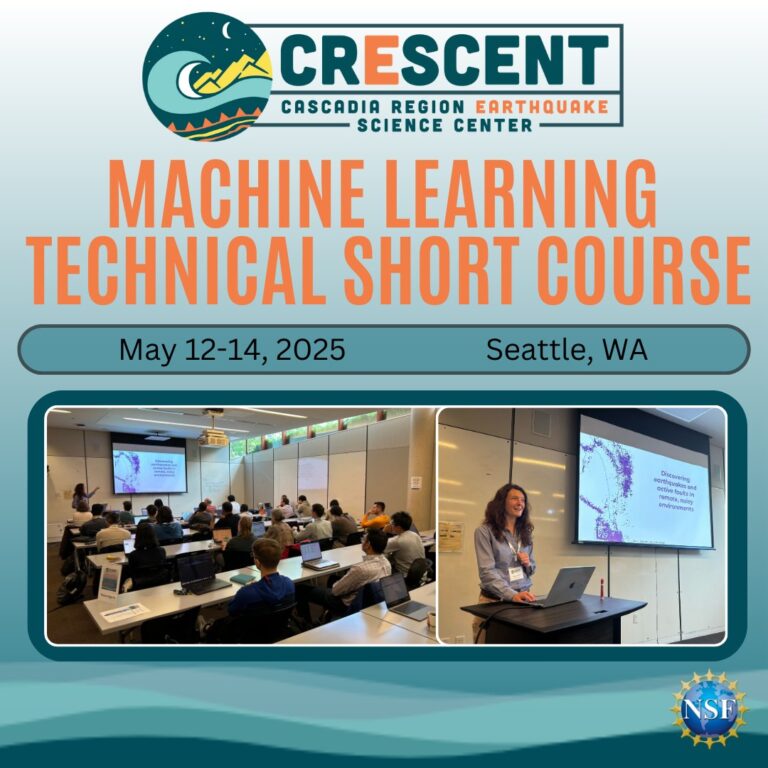
Machine Learning Technical Short Course

This three-day short course provides a hands-on introduction to machine learning techniques for seismic event analysis. Participants will learn to develop AI-aided earthquake catalogs through three key steps: event detection, association, and location with quality control. The course covers neural network architecture selection, model training, performance metrics, and application to continuous seismic data. The workshop will include a mix of presentations and hands-on tutorials. The final day will include a participant hack-a-thon in which students attempt to develop a machine learning based quality control workflow to apply to future generations of machine learning earthquake catalogs.

Machine Learning Technical Short Course Read More »

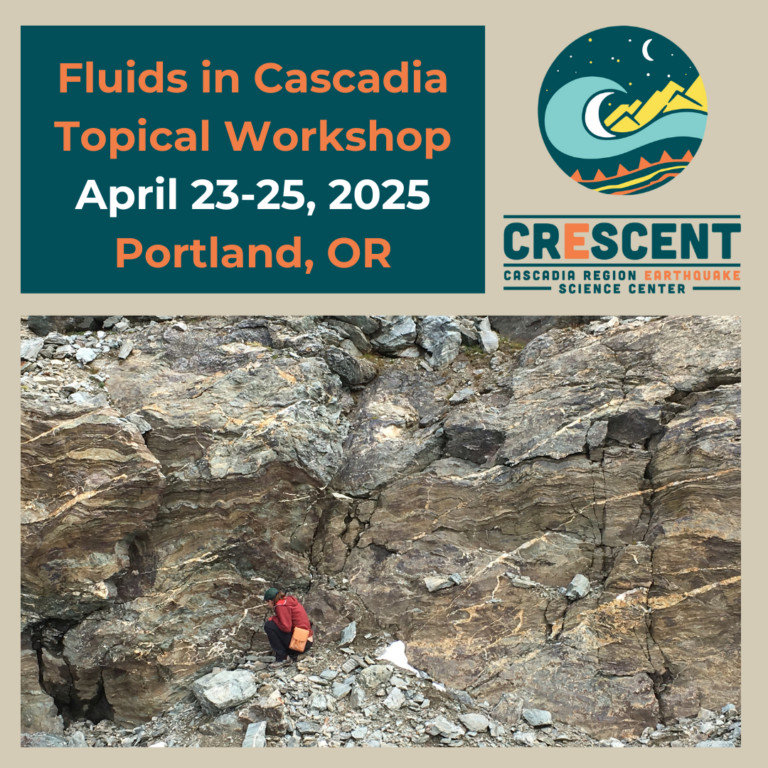
Fluids in Cascadia Topical Workshop

Fluids are ubiquitous in subduction zones and play a fundamental role in modulating many observed processes along the megathrust and other related faults, including slip behaviors and deformation mode. This cross-disciplinary workshop brings together geophysicists, geologists, geochemists, and modelers to discuss the role of fluids in Cascadia.

Fluids in Cascadia Topical Workshop Read More »

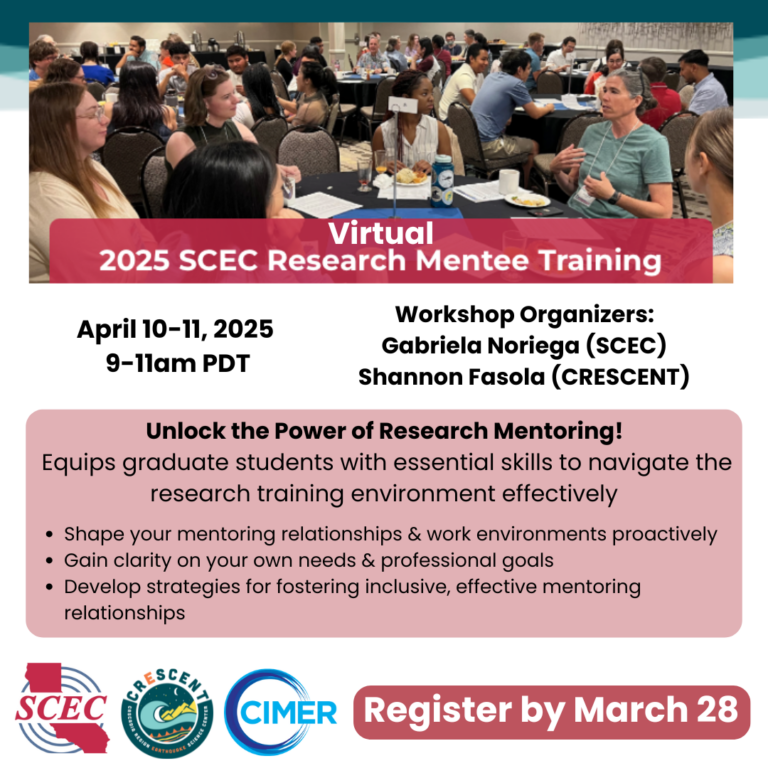
Spring 2025 Mentee Training

Graduate Students Unlock the Power of Research Mentoring!

Statewide California Earthquake Center – SCEC and CRESCENT are co-facilitating an interactive training to equip graduate students with essential skills to navigate the research training environment effectively. This training is built on the evidence-based Entering Mentoring curriculum from the Center for the Improvement of Mentored Experience in Research (CIMER).

Spring 2025 Mentee Training Read More »