CRESCENT AGU 2026

Here’s where you can find us at this year’s American Geophysical Union Fall Meeting.


Here’s where you can find us at this year’s American Geophysical Union Fall Meeting.
November 5, 2026
The C3S working group is organizing a community exercise to evaluate and compare approaches for detecting slow slip events along the Cascadia Subduction Zone from continuous GNSS observations. All participants work with a common 2010–2025 dataset and submit candidate events in a standardized format, providing a basis for comparing different detection approaches.
The exercise is intended to encourage collaboration, reproducibility, and the development of new approaches, with code and results remaining available for ongoing community use. Exercise documentation and submission links are provided below.
C3S Transient Detection Exercise Informational Session Read More »
September 15 & 30, October 14, 21 & 26, 2026
Join EWEB and CRESCENT at the YMCA for an informative session on the Cascadia Subduction Zone and what a major earthquake could mean for the Eugene area. Learn what to expect during a seismic event, understand the potential impacts on community infrastructure, and discover practical ways to prepare your household through EWEB’s Pledge to Prepare program.
Cascadia Subduction Zone Earthquake Presentations Read More »
On October 15, 2026, the University of Oregon joins millions of others across the world to participate in ShakeOut, an annual earthquake awareness drill. Participants practice how to protect themselves during an earthquake – the researched three steps of “Drop, Cover, and Hold On” should be performed as soon as shaking is felt or you receive an earthquake early warning alert.
2026 Great Oregon ShakeOut Read More »

The CRESCENT Seed Grant Program has the dual goals of broadening community participation and increasing the breadth of scientific investigations related to the center’s goals. The center invited the community to participate through a proposal call to address key scientific challenges identified through CRESCENT’s three major pillars. This year we had 33 seed grant applicants of which 11 were funded.
2026-27 Seed Grant Awards Read More »
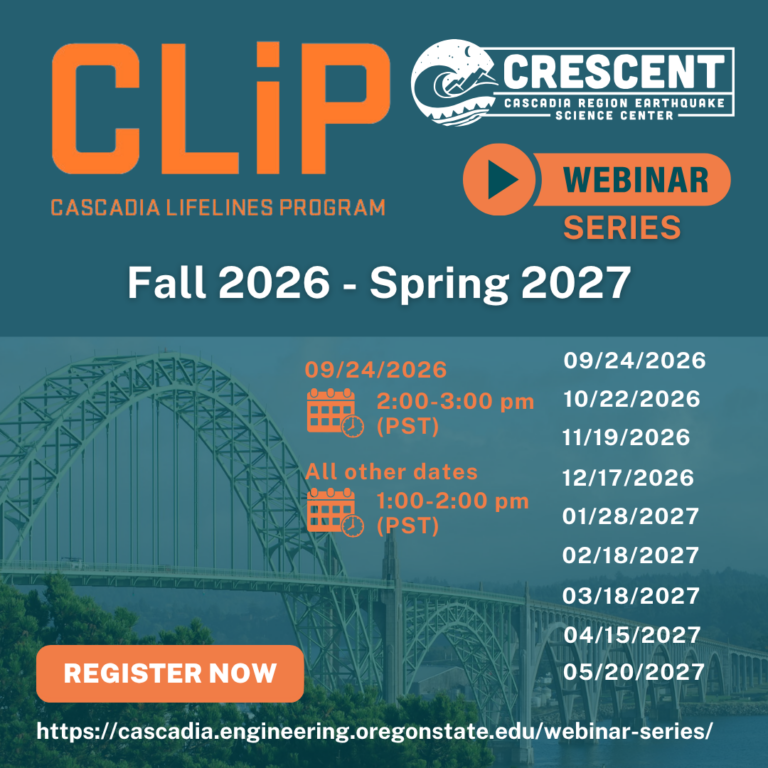
Coordinated in collaboration with CRESCENT, the CLiP Webinar Series showcases advances in seismic hazard assessment, infrastructure design, and earthquake resilience initiatives. These monthly webinars are free to the community and will be of particular interest to practicing engineers, industrial scientists, and policy makers.
CLiP Webinar Series 2026-27 Read More »
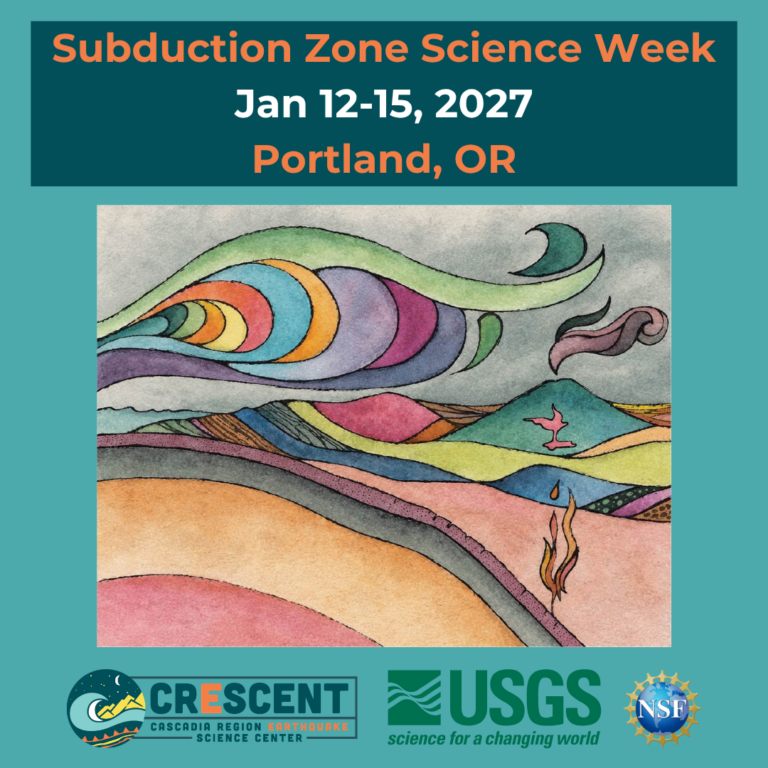
January 12-15, 2027
Subduction Zone Science Week will convene the nation’s leading subduction zone researchers, federal scientists, engineers, and community partners to integrate global and Cascadia-focused knowledge across earthquakes, tsunamis, volcanoes, landslides, and cascading hazards.
Subduction Zone Science Week is co-organized by the USGS and CRESCENT to focus broadly on the subduction zone natural hazards and community resilience. The goals are to:
– Foster collaboration between subduction zone and multi hazard researchers;
– Bridge gaps, and increase communication among subduction zone research groups; and
– Identify and encourage synergistic collaborative activities in U.S. and global subduction zones.
Subduction Zone Science Week 2027 Read More »
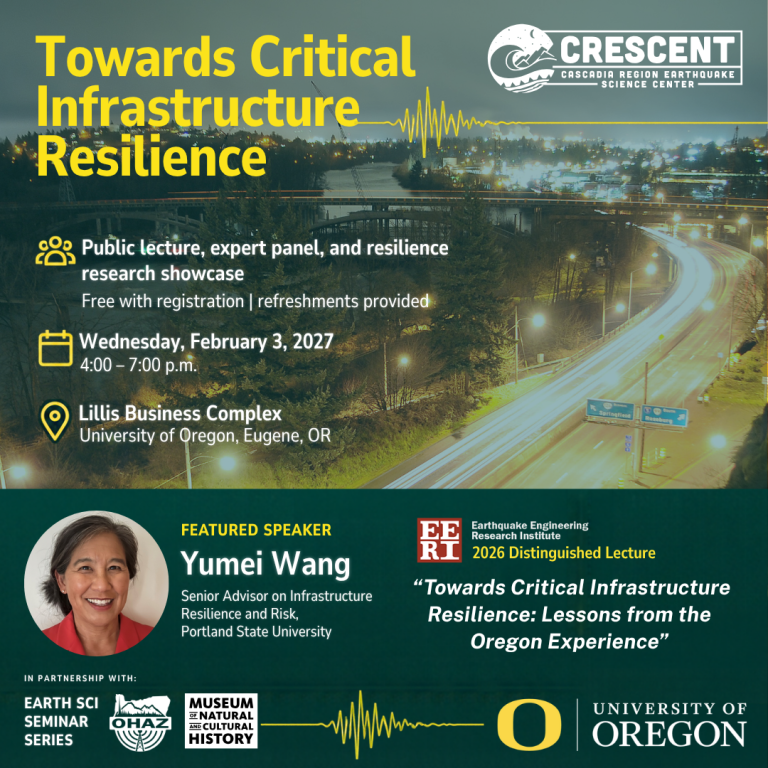
February 3, 2027
Join us at the University of Oregon for a presentation from 2026 EERI Distinguished Lecture Award recipient Yumei Wang, followed by a panel discussion with regional policy and infrastructure leaders, and a reception highlighting student and faculty resilience research.
Towards Critical Infrastructure Resilience Read More »
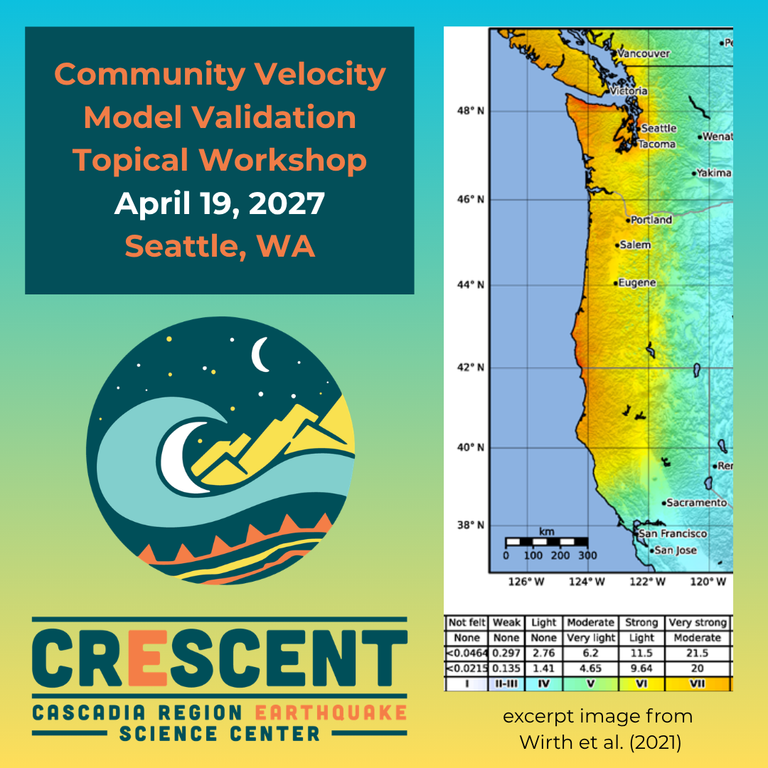
The output of physics-based ground motion simulations, earthquake relocations, and a number of other applications, depend heavily on the accuracy of seismic velocity models. In particular, if physics-based ground motion simulations are to be used towards seismic hazard assessment in the Cascadia Subduction Zone, they will require validation to assess their accuracy in predicting ground motion intensities.
This workshop will showcase existing efforts towards validation of the CRESCENT CVM, upcoming CVM updates, and host discussions of key needs and implications of validation work.
Community Velocity Model Validation Workshop Read More »
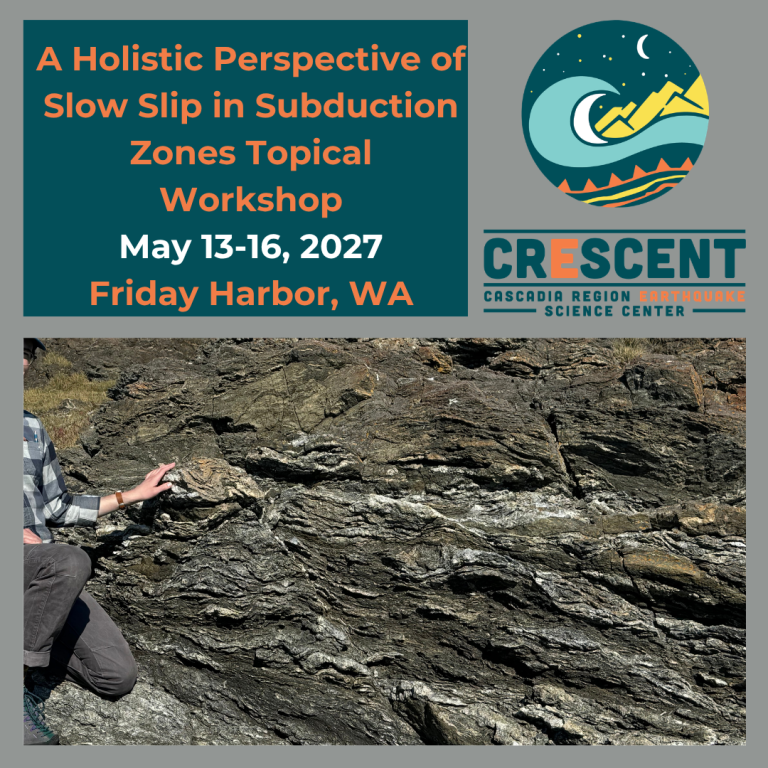
A Holistic Perspective of Slow Slip in Subduction Zones: Integrating geophysical, geologic, experimental, and modeling insights.
This interdisciplinary workshop will bring together a wide range of scientific perspectives and expertise to understand the mechanisms and conditions of slow slip phenomena in subduction zones. Slow slip refers to shallow to deep aseismic transient slippage (slow slip events), which often is accompanied by tectonic tremor, low frequency earthquakes, and earthquake swarms. The rock record also contains evidence of slow slip, and similar phenomena are observed in laboratory experiments, in natural analogs (e.g., landslides, glaciers), and computer models.
A Holistic Perspective of Slow Slip in Subduction Zones Topical Workshop Read More »