

GEI Undergraduate Twinning Program
2026-2027 Students

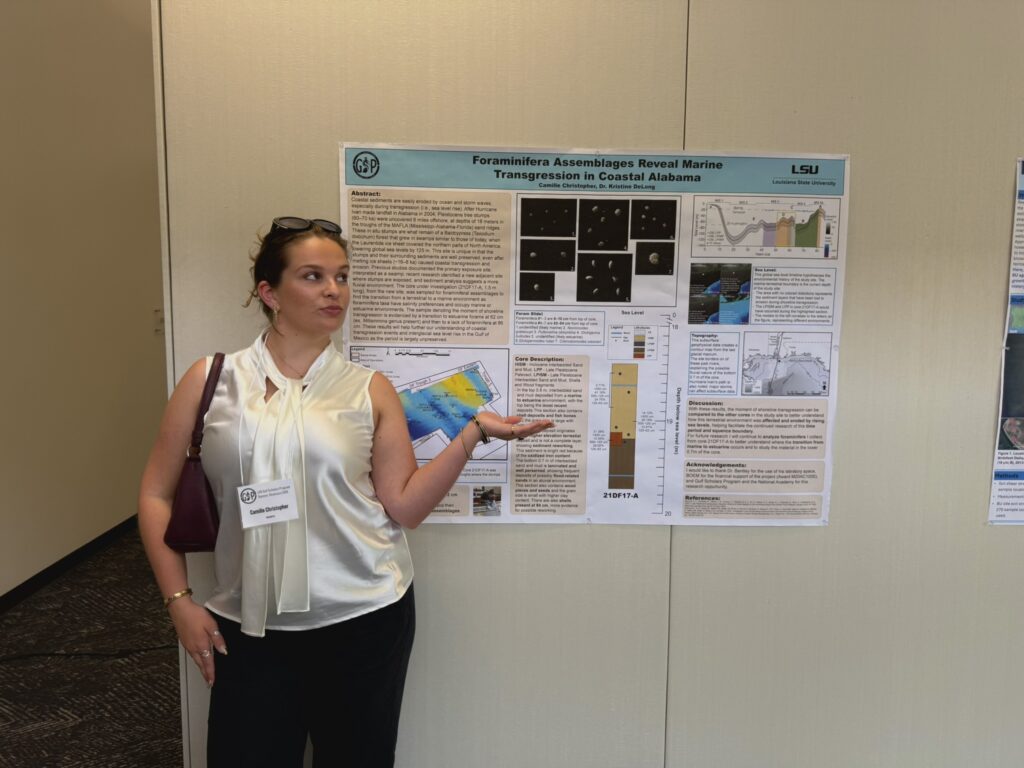
Camille Christopher
Louisiana State University
Subduction Zones in the 21st Century, from the Field to the Classroom

Mentors:
Carolyn Tewksbury-Christle, Fort Lewis College
Eirini Poulaki, Louisiana State University
Student Bio:
Camille Christopher is a third-year Geology major at Louisiana State University, where she also has a minor in Wildlife Ecology. She is very passionate about learning how Earth’s processes interact with each other in the short and long term, and how human activity interfere with these natural cycles. Last summer, Camille was chosen as a Gulf Scholar in LSU’s Gulf Scholars Program where she studied the presence foraminifera and other microfossils to reconstruct shoreline transgression. She holds the positions of Event Planner for her university’s Geology Club and Vice President Inclusion for her sorority Pi Beta Phi. In her free time, Camille loves listen to live music, play tabletop games with her friends, spend time in nature, and go to the movie theater.
Project Summary:
Students learn best when they are able to get hands-on with real world data and problems. Subduction zones are an excellent sandbox to explore everything from structural geology and metamorphic petrology to igneous processes to geophysical data, but many classrooms do not have easy access to the rocks or data that can be collected from modern subduction zones or exhumed subduction-related rocks. Research into exhumed subduction complexes is producing cutting-edge structural, geochemical, geochronologic, geophysical, seismic, and rheologic data that we want to make accessible so that faculty can bring subduction zones into their classroom regardless of where they are located and the resources they have. Virtual Field Experiences (VFEs), including static imagery, videos, maps, drone imagery, 3D models of outcrops and rocks, and field data allow students to experience field research even when getting out in the field is not possible due to location, funding, or accessibility concerns. In addition to VFEs, published data for exhumed subduction complexes provides opportunities to explore and interpret genuine research data from a wide range of fields. Activities investigating subduction zones can be incorporated into many different courses to give students experience with different datasets. Active learning like this improves student retention of course materials and increases student success across a wide range of student backgrounds.
For this project, we plan to leverage published data collected by our research groups in exhumed subduction complexes around the world to create a Virtual Field Experience and a suite of associated activities that could be adapted and adopted into upper-level undergraduate or graduate-level courses at any institution. We will specifically focus on designing several different options (e.g., field-focused vs. lab-focused) and at several different levels (e.g., undergrad vs. grad) to make these as widely usable as possible. We will share these on the Teach the Earth website as a part of the Science Education Resource Center (SERC).
Jenai Clahar
Fort Valley State University
Characterizing Earthquake Swarms and Aftershock Sequences in Southern Cascadia
Mentors:
Mike Brudzinski, Miami University
Aditya Kar, Fort Valley State University
Student Bio:
Jenai Clahar is a rising junior majoring in mathematics and minoring in geology. A member of Fort Valley State University’s Cooperative Developmental Energy Program, Jenai is focused on gaining research experience to prepare herself for graduate school. Her long-term goals are to recieve a PhD in the geosciences and secure a job at NASA. In her free time, she enjoys reading, playing video games, and writing narratives with her friends.
Project Summary:
Earthquake swarms have been increasingly recognized as important parts of the earthquake cycle. This is of particular interest in subduction zones where swarms can potentially be driven by aseismic slip, increased fluid pressure, or stress interactions across spatial and temporal scales. We propose to explore the prevalence of swarms in southern Cascadia where the seismicity rate is the highest throughout the subduction zone. CRESCENT is working on a unified machine-learning catalog for Cascadia seismicity that would be ideal for our project, but if it is not yet available, we plan to use the NCEDC double-difference catalog from 1984 to the present (Waldhauser, 2009) (https://www.ncedc.org/ncedc/catalog-search.html). We will utilize an approach recently developed in the Mexico subduction zone that is designed to assist with identifying swarm activity. This approach first identifies clusters of earthquakes in space and time using the nearest neighbor technique (Zaliapin and Ben Zion, 2013). These clusters of earthquakes are then evaluated on a spectrum of behavior from mainshock-aftershock to swarm-like based on five attribute calculations developed by Ventura-Valentin (in revision) (code: https://doi.org/10.5281/zenodo.14474411). The algorithm uses quantitative characteristics derived from Omori, Båth, and Gutenberg-Richter laws: magnitude difference relative to largest event, when the largest event occurs, seismicity rate over time, maximum magnitude over time, and ratio of the magnitude range to number of events. When applied in the Mexico subduction zone to clusters with at least 10 events, the approach identified twice as many swarms as aftershock sequences. Preliminary analysis as part of USGS EHP project indicates that seismicity in the Alaska subduction has the opposite, with twice as many mainshock-aftershock sequences as swarms. One possible explanation for the higher level of swarm activity in Mexico compared to Alaska is the warmer temperature of the subducting plate, potentially leading to higher fluid pressures that lower effective stress. If true, then we would expect the Cascadia subduction zone to also have prevalent swarm behavior. We propose to characterize the behavior of seismicity in southern Cascadia to investigate this potential relationship.
Emma Fiala
Cal Poly SLO, Maritime Academy
Evaluating the Real-World Impacts of Earthquake Early Warning in the US
Mentors:
Gabriel Lotto, University of Washington – Pacific Northwest Seismic Network
Samantha Stanley, Caltech
Student Bio:
Emma is a sophomore at the Cal Poly Maritime Academy double majoring in International Strategy and Security and Oceanography. Emma is interested in public policy related to protecting natural resources and promoting disaster resiliency. She works as a research assistant on a NOAA National Estuarine Research Reserve study and is a recipient of a CSU COAST research grant. She also serves as Vice President of InterVarsity, an ambassador for the Community Engaged Learning Center, and an assistant coach for the Carlsbad High School Speech and Debate team. Emma was recognized as a Speech and Debate Academic All-American and National Outstanding Rural Scholar. She hopes to pursue a career in water or disaster policy, using scientific research to help communities address complex challenges.
Project Summary:
This project will engage an undergraduate student in applied earthquake hazards science focused on the ShakeAlert, the Earthquake Early Warning system for the U.S West Coast. The student will work with practitioners at two institutions to explore how the public and technical engagement component of operational warning system translates into public benefit, and how that benefit can be measured, evaluated, and improved.
Rather than being hypothesis-driven, the project will utilize qualitative data collection and analysis methods to thematically explore engagement with ShakeAlert’s technical partners. The student will gain experience working with survey datasets, evaluation metrics, stakeholder perspectives, and communication products – including fact sheets, scientific graphics, and social media products – that sit at the intersection of geophysics, social science, and public safety. The student will gain experience in speaking with technical and general audiences, and presenting complex scientific information clearly and precisely.
Sofie Jensen
San Jose State University
Influence of Megathrust Geometry on Cascadia Earthquake Ruptures
Mentors:
Elizabeth Madden, San Jose State University
Megan Anderson, Washington Geological Survey
Ashley Streig, Washington Geological Survey
Student Bio:
Sofie is a fourth-year student at San Jose State University in California studying data science and aspires to start a Master’s Degree in something related to geology. They discovered their love of geology when they took two geology courses at their university: one about dinosaurs and early life and the other about rock formations. Since then, they’ve looked for how to apply data science to geology and not long after, they found this program. Sofie hopes to spend their career doing something that benefits Earth. Outside of academics, Sofie competes in fencing, enjoys studying languages, and dabbles in mixology.
Project Summary:
Earthquakes pose a significant threat to lives and livelihoods in the Pacific Northwest of the United States. However, the last large earthquake along the Cascadia subduction zone occurred in 1700, before modern instrumentation. This project is focused on mitigating seismic hazard in the region by (1) comparing physics-based models of potential Cascadia rupture scenarios on faults with different three- dimensional geometries and (2) summer field work in Washington state using gravimetry to identify the three-dimensional geometries of faults.
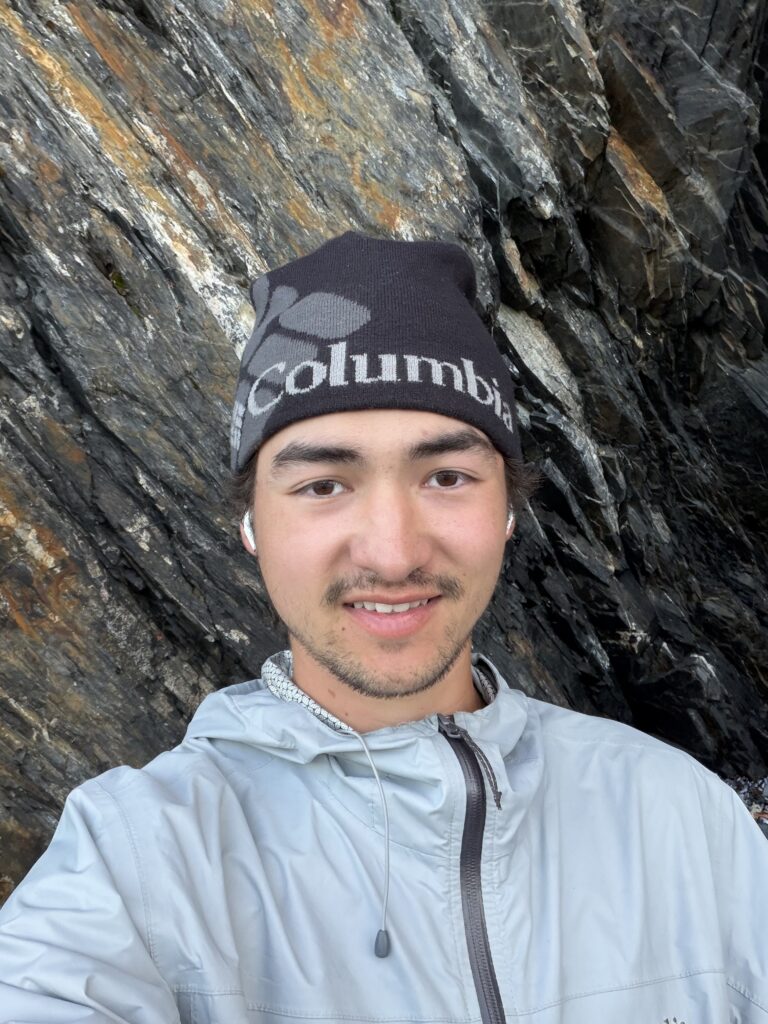
Andrew Lindquist
University of Oregon
Comparative Analysis of Slab-edge Driven Upwelling in Cascadia and the Pacific Ring of Fire System
Mentors:
Margarete Jadamec, The State University of New York at Buffalo
Maureen Long, Yale University
Student Bio:
Andrew Lindquist is a fourth-year undergrad at University of Oregon, majoring in Earth Science with a geophysics concentration, and pursuing a minor in Physics as well. Andrew is interested studying natural hazards, natural resources, geodesy, and earthquake resilience. Outside of school, Andrew enjoys playing basketball, biking, backpacking & hiking, and playing poker.
Project Summary:
With advances in computational resources, geodynamic models have been able to incorporate increasing levels of complexity into the model design, thus enabling a more realistic representation of subduction zones in numerical simulations. This is especially important as the three-dimensional slab geometry, including slab edges, gaps, and intersections, has been shown to have a first-order effect on the flow dynamics. The CRESCENT researcher will use an automated framework to compare the flow results from numerical simulations of the Cascadia subduction zone with the flow results from previously run simulations of other subduction zones in the Pacific Ring of Fire system. This comparison and contrast approach will allow for differing styles of slab-edge driven upwelling to be analyzed, specifically in terms of driving anomalous off-axis volcanism in subduction zones, with the goal of identifying processes unique to the north and south slab edges in Cascadia. In addition, the researcher will plot shear wave splitting results from Cascadia and the comparative subduction zones, using seismic anisotropy to further constrain the slab-edge driven flow dynamics. This will be a joint effort supervised by a geodynamicist and seismologist, with over 20 years experience working on the dynamics of subduction systems from both a geodynamic and seismic perspective. The undergraduate researcher will gain experience learning to program in MATLAB and python, with the programming skills easily transferable to future projects. In addition, the student will gain experience in the fundamentals of numerical modeling, seismology, and constraints from rock deformation experiments, as they relate to mechanisms of slab-edge driven volcanism and hazards in Cascadia.
