

Product Release:
3D Fault Construction QGIS Toolkit
Announcement
CRESCENT is pleased to share a new set of open-source tools for building realistic 3D fault surfaces directly in QGIS (a free, cross-platform GIS application). These tools are designed to help researchers create non-planar, data-constrained fault geometries from standard geologic and geophysical inputs, including geologic maps, balanced cross-sections, seismic images, and earthquake hypocenters.
About the Tools
The workflow consists of three interoperable QGIS plugins:
CrossSectionDigitizer – Digitize and georeference fault traces directly from cross-section or seismic images.
Contours2Mesh – Convert structural contours into triangulated 3D fault surfaces.
Modified Qgis2threejs – Visualize fault surfaces, cross-sections, topography, and seismicity together in an interactive 3D environment.
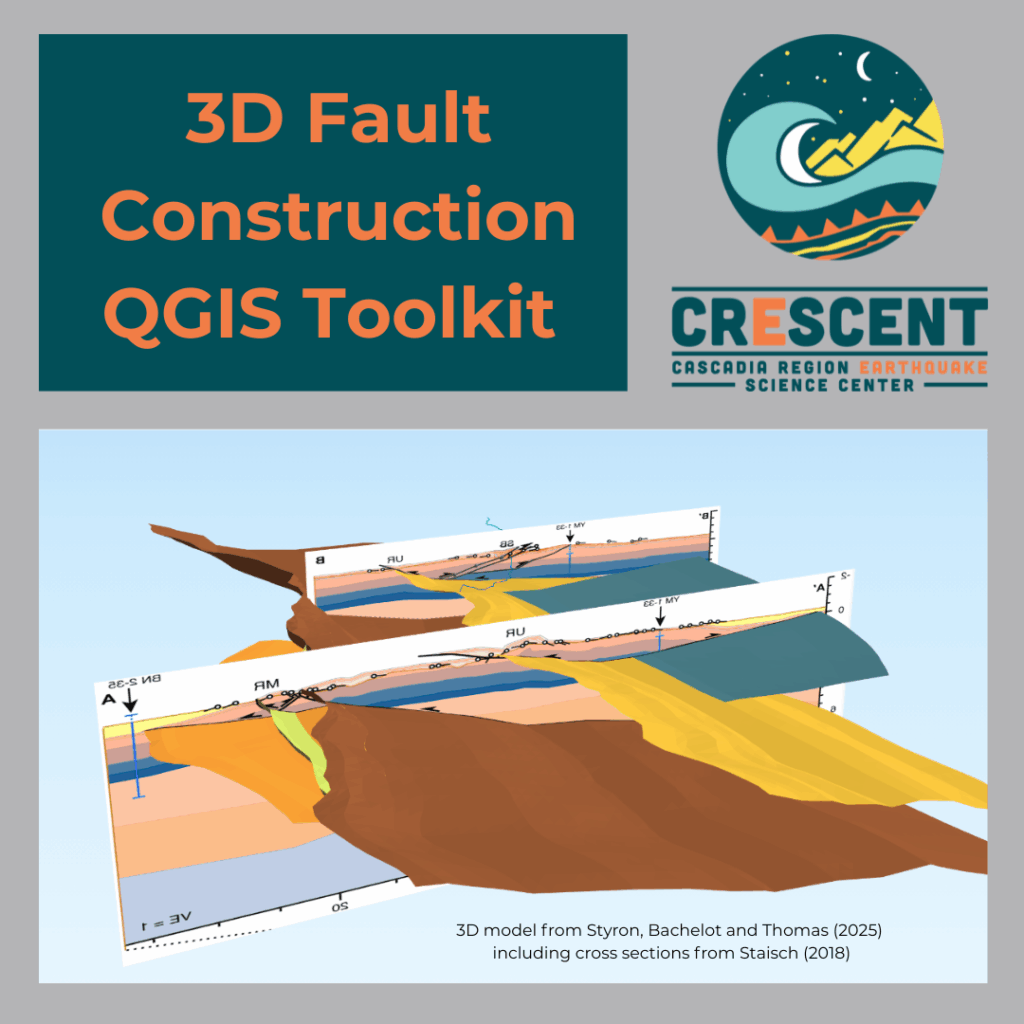
Taken together, these tools provide a complete workflow from interpretation to visualization, enabling the construction of complex fault geometries without the need for proprietary software or specialized modeling platforms. The tools work on Windows, Mac and Linux and support a wide range of applications, including:
- development of community fault models,
- seismic hazard and rupture modeling,
- integrated interpretation of geologic and geophysical data,
- teaching and training in structural geology and tectonics.
Learn More and Try the Tools
For those interested in more technical details and examples, we have also prepared a tutorial demonstrating the tools and a short manuscript.
We welcome users to try the tools, offer feedback, and contribute to their continued development using the CRESCENT GitHub.
More information is available on the CRESCENT Community Fault Model (CFM) Working Group webpage.
