

GEI Undergraduate Twinning Program
2025-2026 Students
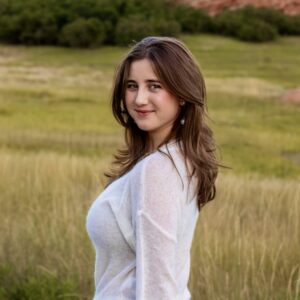
Gigi Albers
Colorado School of Mines
Enhancing Pacific Tsunami Warning Center Operations Through Geospatial Data Analysis and Visualization

Mentors:
Jonathan Weiss, NOAA/NWS/Pacific Tsunami Warning Center
Helen Janiszewski, University of Hawaii – Manoa
Student Bio:
Gigi Albers is a second-year student studying Geophysical Engineering with a Hazards Track at the Colorado School of Mines, where she is also pursuing minors in Planetary Science and Mining Engineering. She recently interned at her institution with the Surface Water and Ocean Topography (SWOT) Mission, contributing to research on climate change and coastal systems. Gigi is a member of the Sigma Kappa Zeta Pi chapter, the Society of Student Geophysicists, and the Society of Women in Geoscience. Outside of academics, she loves hiking, baking, and unwinding with reality TV shows. Gigi aspires to a research-driven career in geohazards and planetary science, with the long-term goal of becoming a professor.
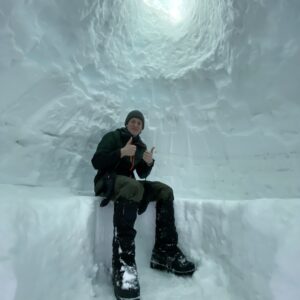
Dash Fitzgerald
Whitman College
Exploring linkages between larger-scale aseismic slow fault slip and accompanying smaller-scale fast seismic slip
Mentors:
Joan Gomberg, U.S. Geological Survey
Katheryn Materna, University of Colorado Boulder
Student Bio:
Dash Fitzgerald is a junior at Whitman College majoring in Geology and Computer Science. A first generation student, Dash works in his FGWC community to help broaden access to higher education. He also serves his community as a Wilderness First Responder and as a climbing instructor. In his free time Dash enjoys backpacking, climbing, kayaking, and playing music.
Project Summary:
This project focuses on understanding the various ways in which faults slip, particularly when at large-scale they slide so slowly that they are not considered ‘regular’ earthquakes and don’t radiate destructive seismic waves. These ‘slow slip events’ do seem to be accompanied by a tiny amount of ‘fast’ slip that radiates seismic waves that are observed as tiny overlapping ‘tremor’ signals or as swarms of distinct but small earthquakes. This project explores the connection between tremor and swarms and the larger-scale slow slip that is hypothesized to initiate or ‘trigger’ clusters of smaller seismic events. We will analyze data from both seismic and geodetic (e.g. GPS) monitoring networks for this exploration.
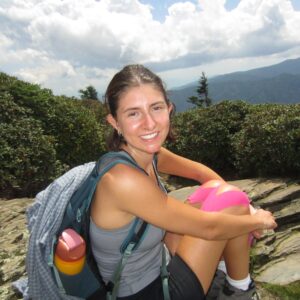
McKenna Ridgley
Miami University Oxford
Assessing and Sharing Risk with a Rapid Earthquake Damage Estimation Tool for the Cascadia Region of Western Canada
Mentors:
Mike Brudzinski, Miami University Oxford
Tiegan Hobbs, Geological Survey of Canada; University of British Columbia
Student Bio:
McKenna (she/her) is a third-year student at Miami University, pursuing a degree in Geology and Environmental Earth Science. She is passionate about exploration and eager to gain new experiences in a professional setting while making meaningful contributions. In her free time, McKenna enjoys being outdoors, hiking, music and spending time with family.

Atiya Simon
The City College of New York
Quantifying infrastructure resilience to volcanic hazards in Cascadia
Mentors:
Einat Lev, Columbia University
Nathaniel Klema, Fort Lewis College
Student Bio:
Atiya is an Earth System Science and Environmental Engineering student at The City College of NY. Her educational focus is on environmental engineering with an emphasis on climate and resilient infrastructure. Atiya is interested in geotechnical systems, hazard modeling, and climate smart design solutions for vulnerable communities. Atiya has a passion for climate-smart design and community resilience. In her free time, she enjoy spending time with family, riding bikes, going to live performances and watching sci-fi tv and movies.
Project Summary:
This project will develop a formal educational collaboration between the Lamont-Doherty Earth Observatory (LDEO) and the Engineering/Applied Physics department at Fort Lewis College (FLC), which is an MSI identified as a Tribal Serving Institution. The work will leverage existing tephra dispersion models accessible through the VICTOR project by using model outputs for potential eruptions of high-threat volcanoes in the Cascades subduction zone as initial conditions for assessing structural stability and resilience of infrastructure in surrounding communities. A student with a background in structural/civil engineering or physics will learn to identify vulnerable structures and generate load maps for a range of eruption scenarios. Scenarios will be informed by the current understanding of potential eruption behaviors at South Sister, Mount Hood, Mount St Helens, Mount Adams, and Mount Rainier. In addition to providing access for an FLC student to the expertise and resources available at LDEO, this project would expose the student to interdisciplinary research that connects volcanology to civil/structural engineering, thus increasing the societal impact of open-source volcanology codes and the VICTOR platform.
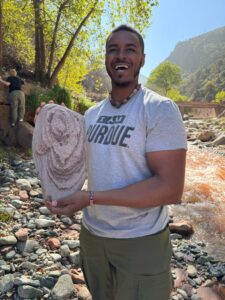
Cayden Woolery
Purdue University
Earthquake detection using machine learning tools in the Valles Caldera, New Mexico
Mentors:
Urbi Basu, New Mexico Institute of Mining and Technology
Akram Mostafanejad, EarthScope Consortium
Student Bio:
Cayden is a third-year undergraduate student at Purdue University, majoring in Geology/Geophysics and Planetary Science, and minoring in French. His focus lies mainly in the sphere of geophysics with a passion for seismology, vulcanology, and hazard detection. At school, Cayden takes pride in being an ambassador for the College of Science, the Multicultural Science Program, and the Earth, Atmospheric, and Planetary Department as he strives to ensure that every student- regardless of background or identity- has a voice on campus and in the greater scientific community. In the future, he hopes to work as seismologist and/or vulcanologist for USGS. Outside of academics, Cayden enjoys hitting the gym, hiking, watching a good movie, and hanging with friends.
