

CRESCENT Topical Workshop
At the Shallow Frontier: Faulting, Deformation, and Tsunamigenesis in Cascadia
May 28-29, 2026
Eugene, OR
Workshop Goals

At the Shallow Frontier: Faulting, Deformation, and Tsunamigenesis in Cascadia
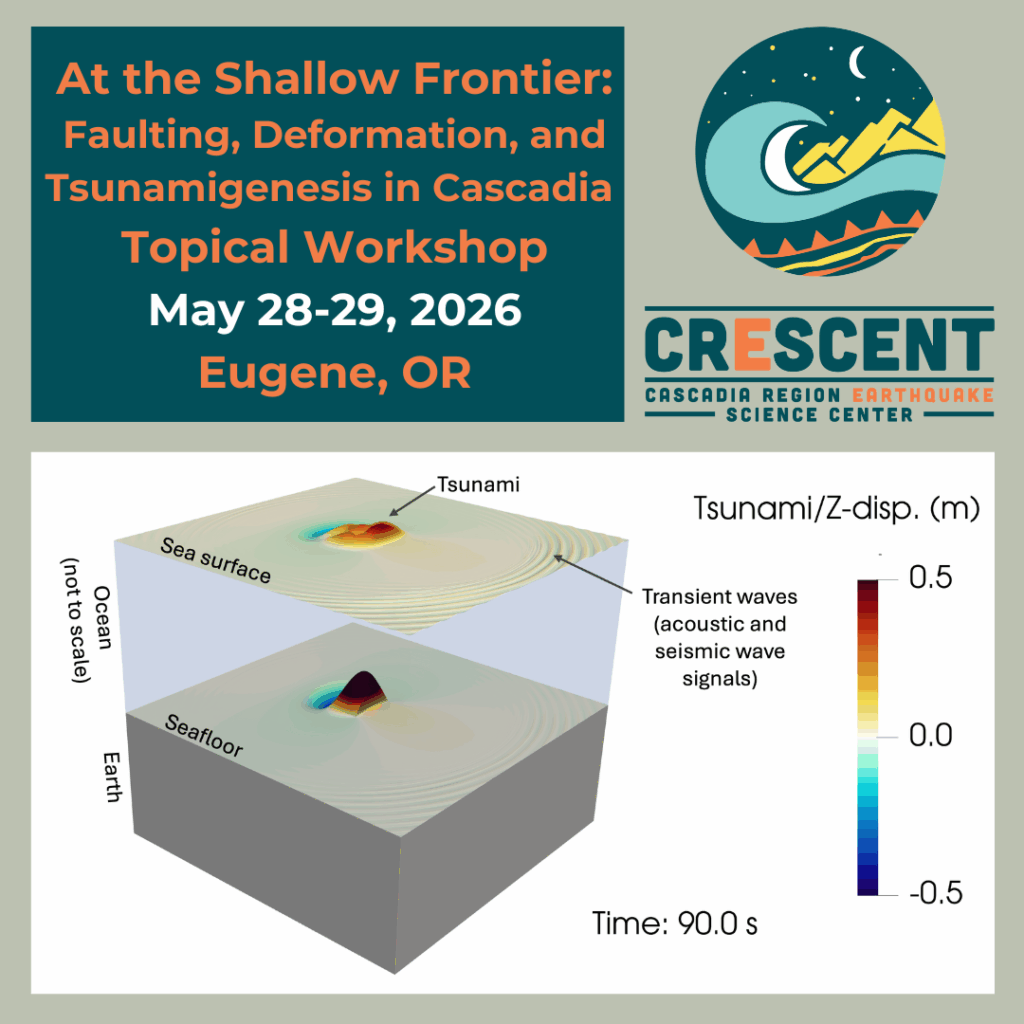
This interdisciplinary workshop aims to integrate experimental, field, and modeling results on shallow faulting, deformation, and tsunamigenesis for the Cascadia Subduction Zone. We welcome interdisciplinary participants interested in tsunami generation and shallow frictional fault properties, seismic and aseismic slip, fluids, splay faulting, off-fault deformation and subduction zone structure. We welcome contributions focusing on methodological advances using acoustic laboratory studies, geophysical imaging, paleoseismology, seafloor geodesy and remote sensing, tsunami source characterization and inversion, community modeling benchmarks, and offshore distributed acoustic sensing (DAS).
The goal of the workshop is to discuss recent advances and outline research priorities for Cascadia on the following topics:
1) Physics of shallow tsunamigenesis
2) Shallow faulting and deformation
3) Implications for hazard and operational frameworks
A key outcome of the workshop will be a community white paper outlining priorities for future research needed to capture the full complexity of shallow rupture, deformation processes, and tsunami generation to improve tsunami hazard assessments for Cascadia.
Application
This workshop application is closed. Please reach out to cascadiaquakes@uoregon.edu for more information.
Travel & Lodging
May 28-29, 2026
Erb Memorial Union (EMU), University of Oregon
Venue
This CRESCENT Topical Workshop will be held at the Erb Memorial Union (EMU) at University of Oregon.
Local information
The EMU is located at the heart of the University of Oregon campus, within easy reach of downtown Eugene and surrounding places of interest. Click here for information on where to eat, drink and recreate, or check this map for more ideas.
Flights and ground transportation
Eugene airport (EUG) is a ~20 minute drive from the meeting venue. There is no public transportation from the airport to the university, though several taxi, shuttle and rideshare options are available.
Parking
The University of Oregon has two main parking garages that are an eight-minute walk from the workshop venue: 13th St Garage and Millrace Drive Garage. Daily visitor permits for other campus lots, including ADA parking spaces, are available via the University’s parking portal.
Lodging
CRESCENT has selected the Residence Inn by Marriott Eugene Springfield as the host hotel. Located 1.6 miles from the meeting venue, the hotel is conveniently located near restaurants and a multi-use path leading to UO campus. Here is a trail map from the hotel to the EMU. PeaceHealth Rides has a couple of bike share hubs near the hotel. Lyft and UBER are also available in the Eugene area.
To book lodging at the Residence Inn negotiated CRESCENT group rate, follow this link and book by April 26, 2026. A hot breakfast buffet is included with the room rate. The property has an outdoor pool, hot tub and fitness center. On-site parking is available at $10 per vehicle, per day.
The Hayward Inn and Best Western New Oregon are hotel options less than a 10-minute walk from the venue though they are likely sold out or very high rates due to a track and field competition taking place at the same time as the workshop.
Poster Session Details
Submit poster info here by May 15
There is an optional opportunity to present a poster at this workshop.
Some key details:
- Poster dimensions should be a maximum of 48” (width) by 36″ (height).
- Please bring your poster to the workshop on Thursday morning.
- CRESCENT will supply you with venue approved tape to hang your poster in the event space.
- Posters will be displayed in space adjacent to the general session space for the duration of the workshop, accessible during breaks. Posters can stay up overnight.
- We will have a poster session on Friday in conjunction with lunch.
- You may remove your poster any time after lunch on Friday.
On Thursday, there will be an optional opportunity for poster presenters to do a lightning talk on their poster content. If you opt into a lightning talk, please submit one PowerPoint slide along with your title/author submission via the link.
Presentation slides and recordings
Agenda
Note: All times Pacific Daylight Time. Details subject to change.
Wednesday, May 27
5:30p – 7:00p Reception
Thursday, May 28
8:00a Check-in
8:30a Welcome
8:55a Session 1: Shallow Faulting and Deformation – Geological Perspectives
“Paleoseismic Data for Constraining Models of Cascadia Earthquake Deformation and Tsunamigenesis” presented by Carrie Garrison-Laney, Coastal Hazards Specialist, Washington Sea Grant / NOAA Liaison
“Tectonic context of extreme shallow slip: the example of the Japan Trench” presented by Jamie Kirkpatrick, Associate Professor, University of Nevada, Reno
“Evidence for active splay faulting and sediment subduction in Cascadia’s accretionary wedge” presented by Anna Ledeczi, Ph.D. Candidate, University of Washington
10:35a Session 2: Shallow Faulting and Deformation – Geophysical Sensing Techniques
“Connections between upper and lower plate faulting, fluids, megathrust properties, and slip behavior: Examples from seismic imaging in the Alaska, Aleutian and Mexico subduction zones” presented by Donna Shillington, Professor, Northern Arizona University
“Using high-resolution geophysics to understand shallow megathrust deformation, coseismic faulting, and tsunamigenesis” presented by Janet Watt, Research Geophysicist, United States Geological Survey
“Submarine landslides and tsunami hazards in the Cascadia subduction zone” presented by Jenna Hill, Research Geologist, United States Geological Survey
12:00p Lunch
1:00p Session 3: Physics of Shallow Tsunamigenesis – Modeling 1
“Shallow Rupture Dynamics and Tsunamigenesis: Opportunities and Priorities for Forward and Inverse Modeling” presented by Eric Dunham, Professor, Stanford University
“Nonhydrostatic modeling of tsunamis from earthquake rupture” presented by Kwok Fai Cheung, Professor, University of Hawaii
“Wedge Inelasticity as a Mechanism for Efficient Tsunami Generation and Weak High-Frequency Radiation in Shallow Subduction Zones” presented by Shuo Ma, Professor, San Diego State University
2:30p Poster Lightning Talks
3:30p Session 4: Physics of Shallow Tsunamigenesis – Modeling 2
“Deciphering Tsunami Records to Understand Subduction Earthquakes” presented by Matias Carvajal, Professor, Pontificia Universidad Católica de Valparaíso
“Evaluating dynamic viability of finite-fault slip models of the 2011 Tohoku-Oki earthquake using ensemble dynamic rupture simulations” presented by Jeremy Wing Ching Wong, Ph.D. Candidate, Scripps Institution of Oceanography / University of California San Diego
“Reducing Uncertainty in Cascadia Tsunami Forecasting via Bayesian Optimal Experimental Design” presented by Stefan Henneking, Research Associate, University of Texas at Austin
5:00p Closing Remarks
5:30p Day 1 adjourns
The Tsunami Sources for Hazard Assessment (TSHA) Special Interest Group will gather informally on Thursday evening after the workshop.
Friday, May 29
8:00a Check-in
8:30a Welcome
8:45a Session 5: Hazard Implications and Operational Frameworks – Implementation of New Knowledge
“Tsunami Sources for Hazard Assessment” presented by Randall LeVeque, Professor Emeritus, University of Washington
“An Overview of NOAA’s Research on Operational and Long-Term Assessments of Tsunami Inundation Hazards” presented by Yong Wei, Senior Research Scientist, University of Washington / NOAA Pacific Marine Environmental Laboratory
“Tsunami Hazard Assessment Along the Coast of British Columbia, Canada” presented by Reza Amouzgar, Applied Science Specialist, Ocean Networks Canada / University of Victoria
10:30a Session 6: Hazard Implications and Operational Frameworks – Implementation of New Knowledge Part II
“USGS Powell Center: PTHA in Cascadia” presented by Jason Patton, Engineering Geologist, California Geological Survey
“Preparing for Future Tsunami Impacts Striking the Oregon Coast” presented by Jonathan Allan, Coastal Geomorphologist, Oregon Department of Geology and Mineral Industries
11:40a Poster Session and Lunch
1:30p White paper Writing Session
All participants are welcome to join the white paper writing session.
3:30p Closing Remarks
4:00p Workshop concludes
Workshop Planning Committee
The planning committee brings decades of combined research experience and bring multi-disciplinary, global perspectives to guide the planning process.
Ignacio Sepulveda
San Diego State University isepulveda@sdsu.edu
Alice Gabriel
University of California, San Diego
algabriel@ucsd.edu
Tianhaozhe Sun
Geological Survey of Canada / Natural Resources Canada
thzsun@uvic.ca
